
Google I/O is Google’s annual developer conference — the event where the company lays out its technology direction for the year ahead, announces new products, and signals where its platforms are heading. For anyone whose business depends on Google Search, Google Ads, YouTube, or the wider Google ecosystem, I/O is one of the most important events on the calendar.
Google I/O 2026 took place on May 19 and 20 at the Shoreline Amphitheatre in Mountain View, California. The headline theme was clear before the event even started, and every announcement confirmed it: AI is no longer a feature Google is adding to its products. It is the product. Every announcement, every new tool, every update across Search, YouTube, Gemini, and shopping was framed through a single lens — generative AI and agentic intelligence.
This guide cuts through the noise. We break down every major announcement from Google I/O 2026 that matters for digital marketers, SEOs, e-commerce businesses, and UAE business owners — with a clear verdict on what each change means for your strategy right now.
📋 What We Cover in This Guide
- AI Mode permanently joins the Google Search results page
- Information Agents on Search — background monitoring for any query
- Ask YouTube — AI-powered video search with timestamp precision
- Docs Live — voice-driven document creation from your Google ecosystem
- Gemini 3.5 Flash and Gemini Omni — the new model architecture
- Gemini Spark — Google’s 24/7 cloud-based agentic AI tool
- Google Pics, Stitch, and Veo — creative and design tools
- Universal Cart — AI-powered shopping across Google’s entire ecosystem
- SynthID expansion — AI content detection now covers ChatGPT and ElevenLabs
- What every UAE business and marketer should do right now
The Two Core Themes Running Through Every I/O 2026 Announcement
Before the individual announcements, it helps to understand the two organising principles that structured almost everything announced at I/O 2026. Once you see them, every product launch and update becomes significantly easier to interpret.
Theme one: Everything is now AI. There was not a single non-AI announcement at I/O 2026 of material significance. Google Search, YouTube, Google Drive, Docs, Google Shopping, the Chrome browser, and Android — every product received updates that are entirely defined by generative or agentic AI. This is not new in direction, but the 2026 event confirmed that Google is no longer treating AI as an upgrade layer on top of existing products. The existing products are being rebuilt around AI from the ground up.
Theme two: Google is catching up by absorbing. Several of the most prominent new tools announced at I/O 2026 closely mirror independent products that have gained significant traction among users and marketers over the past 18 months. The pattern across multiple announcements was consistent: identify a tool that users are actively adopting outside the Google ecosystem, build or acquire equivalent functionality, and integrate it into Google’s existing product suite under a new name. The net effect is that Google is consolidating the functionality of a growing set of third-party AI tools into its own platforms — a significant strategic move that will reshape which tools businesses continue to pay for.
With those two themes as context, here is the full breakdown of every I/O 2026 announcement that matters for marketers and business owners.
Google I/O 2026 — Every Announcement That Matters for Marketers Full Breakdown
1. AI Mode Is Now Permanently on the Google Search Results Page
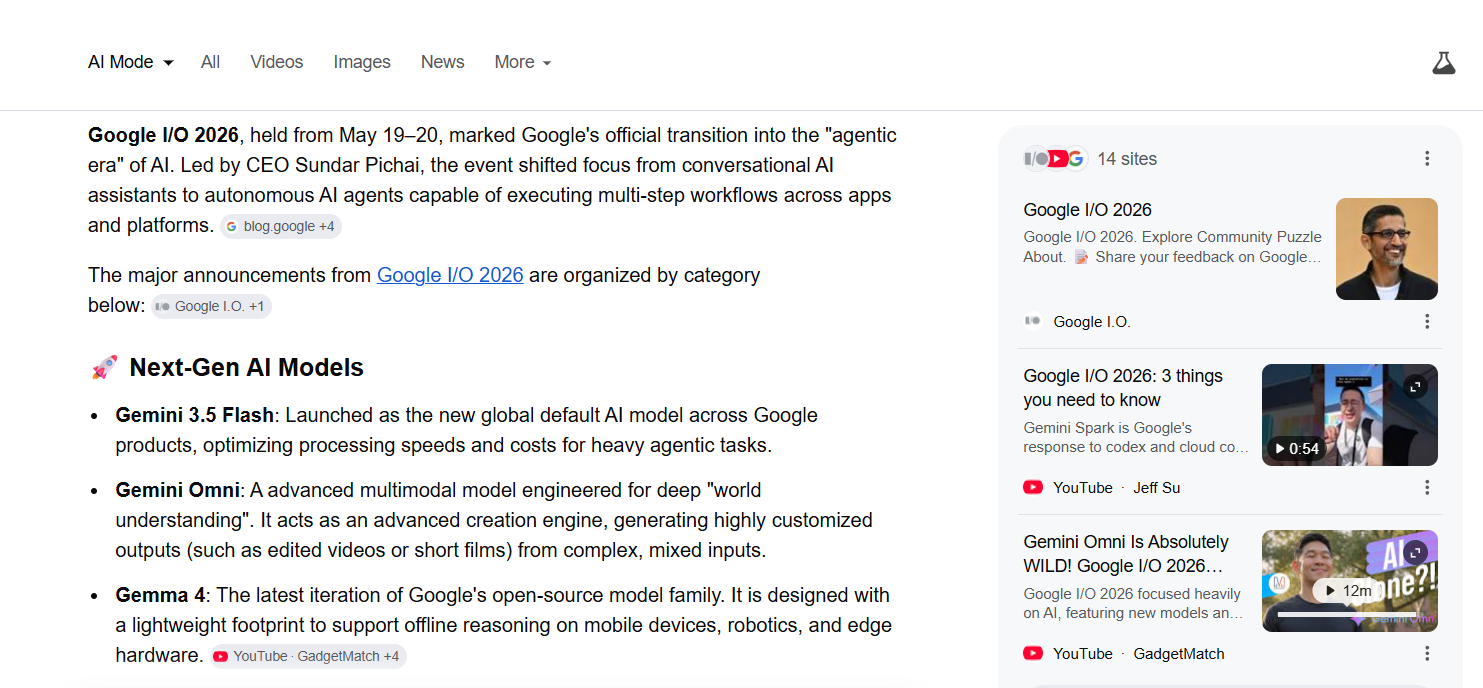
Google Search Highest ImpactThis is the most consequential announcement in the entire event for anyone whose business depends on organic search traffic. AI Mode — Google’s AI-powered answer interface — is no longer a separate tab or optional mode that users must actively choose to access. It is now a permanent, default feature of the standard Google Search results page, powered by the new Gemini 3.5 Flash model.
What this means in practice: when someone searches Google, they will see AI-generated responses and summaries directly on the same page as organic results — without needing to click anything or switch modes. The boundary between the traditional search results page and the AI interface has been removed.
Google has also rebuilt the Search box itself for the first time in over 25 years. The new intelligent Search box expands as you type longer, conversational queries — adapting to the way people now ask questions rather than typing short keyword strings.
Organic click-through rates from traditional rankings will continue to decline as AI-generated answers satisfy more queries on the results page itself. Businesses that structure their content for AI citation — with question-based headings, FAQPage schema, and authoritative original content — will maintain visibility in the AI response layer. Those that do not will become progressively less visible even if their traditional organic rankings hold. Generative Engine Optimisation (GEO) is no longer optional.
2. Information Agents — Background Search Tasks That Run 24/7
Google Search Coming SoonGoogle is introducing agentic capabilities directly into the Search results page. Users will be able to set up Information Agents — persistent background tasks that monitor the web for changes related to a specific query and send notifications when something relevant happens.
For example, a user could instruct Google Search to monitor a specific topic, a competitor’s website, a product price, or a content publisher’s output, and receive a notification whenever a relevant update occurs. The agent operates continuously in the background using Google Search’s real-time web index.
- Available to Google AI Pro and Ultra subscribers initially, rolling out in the US in the coming months
- Agents monitor blogs, news sources, social posts, finance data, shopping prices, and sports results
- Notifications delivered to mobile and desktop
This significantly increases the value of fresh, regularly updated content. If your website publishes new articles, product updates, or announcements, users with active Information Agents on your topics can be automatically notified — creating a passive distribution channel. For competitive monitoring, marketers can track competitor activity, pricing changes, and industry news directly from Google Search without third-party tools.
3. Ask YouTube — AI Search That Takes You Directly to the Right Moment
YouTube Live — US PremiumYouTube’s search experience is being rebuilt with an AI layer called Ask YouTube. When a user searches for a specific topic or problem, Ask YouTube does not just return a list of potentially relevant video titles. It identifies the exact moment within each video where that specific topic is addressed and begins playback from that timestamp — skipping introductions, sponsorship segments, and unrelated content.
After watching, users can ask follow-up questions, and Ask YouTube will answer using the content available across YouTube’s entire catalogue, citing specific videos and timestamps. This is made possible because YouTube holds transcription data for virtually every video on the platform and has trained its AI to understand topic coverage at a per-second level of granularity.
- Currently available for YouTube Premium subscribers in the US via youtube.com/new
- Supports complex queries and follow-up conversational questions
- Surfaces content from across the full YouTube catalogue, not just popular or recent videos
For content creators and brands publishing on YouTube, topical specificity now matters more than ever. Videos that clearly and directly address a well-defined question or problem — particularly in the first few minutes — will be preferred by Ask YouTube’s ranking system. Generic “overview” videos will be bypassed in favour of content that answers specific questions. Adding detailed video descriptions, chapters, and transcripts is no longer optional SEO hygiene — it is how Ask YouTube understands and surfaces your content.
4. Docs Live — Voice-Driven Document Creation Across Your Google Ecosystem
Gemini / Workspace Summer 2026Docs Live brings conversational document generation to Google Drive and Google Docs. Users can speak instructions out loud — without typing — and Google Docs will create, modify, and structure documents based on voice input, pulling relevant information from the user’s Gmail, Drive, and other connected Google services to personalise the output.
Practical applications demonstrated at I/O 2026 included itinerary planning, meeting notes, proposal drafts, and reports — all generated and edited through spoken instructions rather than typed commands, with the AI pulling context from the user’s existing Google account data to make the output relevant and personalised.
For marketing and operations teams that live inside Google Workspace, Docs Live will significantly reduce the time cost of producing first drafts of proposals, reports, briefs, and content outlines. Rolling out first to Google AI Pro and Ultra subscribers in Summer 2026.
5. Gemini 3.5 Flash and Gemini Omni — The New Model Architecture
Gemini Models Flash Live NowGoogle announced two significant model releases at I/O 2026, each targeting a different use case.
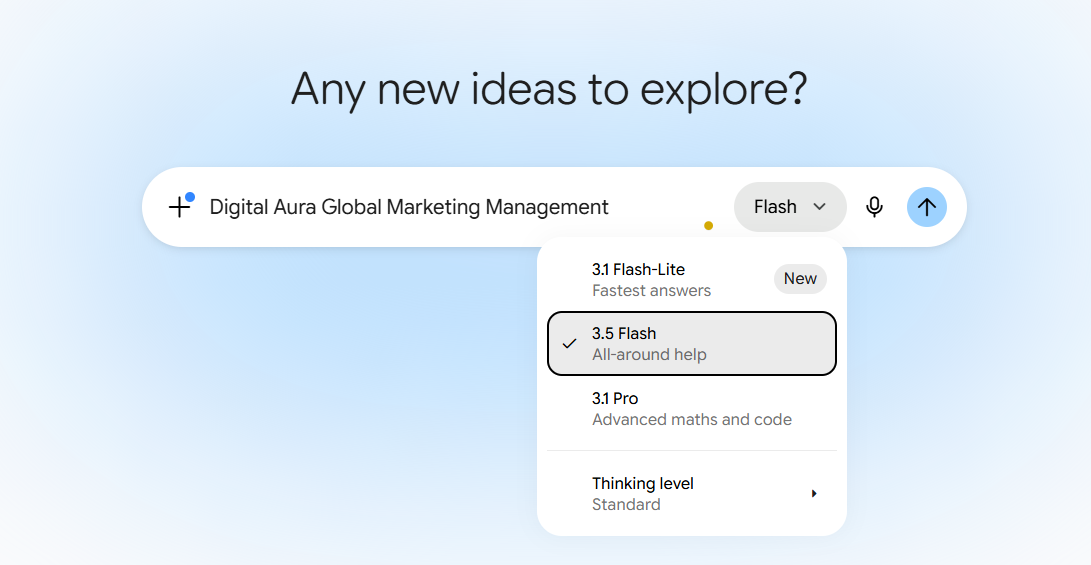
Gemini 3.5 Flash is now the default model powering Google Search’s AI Mode globally. It is positioned as faster, more accurate, and more cost-efficient than the previous Gemini 3.1 Pro, and is already available in the Gemini app. Gemini 3.5 Pro is expected later in the year.
Gemini Omni is a multimodal “world model” — meaning it can work across video, images, and audio simultaneously rather than treating each as separate inputs. Demonstrated capabilities include changing the style of a video (converting realistic footage to cartoon or sketch), replacing video backgrounds, generating 360-degree views from single-angle footage, and converting sketch-based videos into photorealistic output. Google is positioning this as competition to professional video and image editing workflows.
Gemini Omni represents a direct challenge to expensive post-production and video editing workflows. For marketing teams producing video content, the ability to change backgrounds, restyle footage, and generate variations without a full production setup will reduce creative turnaround times and costs significantly — particularly for social media and ad content at scale.
6. Gemini Spark — Google’s Cloud-Based 24/7 Agentic AI Tool
Gemini App Major LaunchGemini Spark is the most strategically significant new product announced at I/O 2026 from a competitive standpoint. It is Google’s answer to the growing category of AI-powered agentic tools that can take multi-step actions on a computer on a user’s behalf.
Gemini Spark connects to Gmail, Google Photos, Google Drive, and third-party platforms via MCP (Model Context Protocol), and can operate across a user’s computer environment to execute complex, multi-step tasks. The key technical differentiation from comparable tools is that Gemini Spark runs on Google’s own cloud infrastructure rather than requiring the user’s device to be on and active. A task assigned to Gemini Spark will continue running and complete even if the user’s laptop is closed, with results delivered via notification to mobile or desktop when finished.
- Available now at USD 200/month (AI Ultra tier) — includes full Gemini Spark capabilities
- A new USD 100/month AI Standard tier has been launched specifically to compete at the mid-market price point
- MCP support for third-party integrations is coming soon — enabling connection to a wide range of external platforms and services
- Google Hello, an Android-specific version of this capability for building and managing local agents on-device, was previewed for future launch
Gemini Spark brings agentic AI — the ability to automate complex, multi-step digital tasks — into Google’s mainstream subscription tiers at a price point accessible to SME teams. For marketing and operations workflows that rely heavily on Google Workspace, Gemini Spark is worth evaluating as a genuine productivity multiplier. The cloud-based execution model removes the requirement to keep a device running, which makes it practical for longer, background tasks like research, reporting, and data compilation.
7. Google Pics, Stitch, and Veo — New Creative and Design Tools
Creative Tools New LaunchesGoogle announced a cluster of new creative and design tools at I/O 2026, each targeting a specific workflow within the visual content production space.
Google Pics is an AI-powered image creation and editing platform that can generate images, modify them, and add text — positioning it as a direct competitor to design tools that offer AI-assisted image generation within a layout environment.
Google Stitch is a web design and UI prototyping tool that introduces real-time multi-cursor animation during the build process — showing visual changes as they happen, including layout reflow and component repositioning. This is designed to make the design-to-code handoff faster and more transparent for development teams.
Veo with Gemini Omni brings video background replacement, style transformation, and roto-scoping capabilities (the ability to isolate and edit subjects separately from backgrounds) into Google’s video tool. These are capabilities that previously required dedicated professional post-production software.
For marketing teams producing visual content in-house, Google’s creative tool expansion reduces dependency on expensive standalone subscriptions for image editing, design, and video post-production. The practical priority for most businesses is evaluating whether these tools can replace or augment existing creative workflows before committing to premium third-party software renewals.
8. Universal Cart and Agentic Commerce — Google Becomes a Shopping Platform
Google Shopping E-Commerce ImpactGoogle’s most commercially significant announcement at I/O 2026 for e-commerce businesses is Universal Cart — an AI-powered persistent shopping cart that aggregates products from across Google Search, YouTube, and Gmail into a single location. When a user encounters a product in a Google ad, an organic product listing, a YouTube video, or even a Gmail email, they can add it to their Universal Cart and return to it later from any Google surface.
The cart includes AI features that add a new dimension to the shopping experience:
- Compatibility checking — the AI flags when products in the cart are incompatible with each other and suggests alternatives
- Price monitoring — alerts users when a better price is available for an item they have saved, across multiple retailers
- Payment optimisation — surfaces credit card and debit card offers that would save money on specific purchases
Alongside Universal Cart, Google expanded its shopping ecosystem significantly. Amazon, Microsoft, Stripe, and Salesforce have all confirmed support for Google’s UCP (Universal Commerce Protocol), meaning Amazon products will now appear natively within Google’s AI Mode search results and can be purchased directly without leaving Google. Google is also expanding its Agentic Payment Protocol (APR2) with new spending restrictions that allow users to set limits on what an AI agent can spend and where.
For UAE e-commerce businesses, Universal Cart makes Google Shopping and Google product listings more strategically important than at any point in the platform’s history. Products that are properly structured in Google Merchant Center, with accurate pricing, high-quality images, and complete product data, will now be surfaced across a much wider range of Google surfaces. Google is actively positioning itself as a commerce intermediary — which means the window to establish strong product listings before the competitive landscape intensifies is now.
9. SynthID Expansion — Google Can Now Detect AI Content From ChatGPT and ElevenLabs
Content Trust SEO CriticalSynthID is Google’s invisible watermarking system for AI-generated content. When any Google AI model — Gemini, Veo, Imagen — generates text, an image, a video, or audio, it embeds an imperceptible digital fingerprint into that content. Google’s own platforms can then detect that fingerprint and confirm whether the content was AI-generated.
Until now, SynthID only worked within Google’s own model ecosystem. I/O 2026 announced two significant expansions:
- OpenAI has joined the SynthID programme. AI-generated text and images from ChatGPT and OpenAI’s API will now carry SynthID-compatible watermarks, meaning Google Search and Chrome can identify them as AI-generated.
- ElevenLabs has joined the programme. AI-generated audio and voice content produced using ElevenLabs will be detectable as AI-generated across Google platforms.
- C2PA Content Credentials — a broader industry standard for content provenance — is being integrated into Google Search and Chrome, allowing users to verify whether any image or piece of content has been altered or AI-generated, regardless of which tool created it.
For SEO and content marketing: the ability of Google to identify AI-generated content across the most widely used generative AI platforms — not just its own — has profound implications for any content strategy that relies heavily on AI-generated articles, images, or audio. This does not mean AI-assisted content is penalised automatically. But it confirms that Google now has the technical infrastructure to distinguish AI-generated content from human-authored content at scale. Investing in genuinely original, expert-authored content that reflects real experience and insight is now a structural long-term advantage.
What Google I/O 2026 Means for UAE Businesses and Marketers — Specifically
Reading through the global implications of I/O 2026 is useful. But the UAE market has specific characteristics that make some of these announcements more or less urgent than the global averages suggest.
The UAE has one of the highest smartphone penetration rates in the world, one of the highest AI assistant adoption rates in the GCC, and a consumer base that regularly uses English and Arabic search queries interchangeably. The impact of AI Mode’s permanent placement on Google Search is therefore acute in the UAE market — where a large segment of the consumer base is already comfortable using AI tools for research, comparison, and purchasing decisions.
The shopping announcements are particularly relevant for UAE-based e-commerce businesses. Google’s Universal Cart and its expanded commerce protocols — now including Amazon — signal a significant shift in how products will be discovered and purchased through Google. Businesses that have not yet invested in structured Google Merchant Center listings, product schema markup, and Google Shopping campaigns are moving into a competitive environment where the stakes for being visible in Google’s commerce layer are rising rapidly.
The SynthID expansion has direct relevance for any UAE digital marketing team using AI-generated content at scale in their SEO strategy. While Google has not announced an explicit penalty for AI-generated content, the ability to detect it cross-platform creates a permanent infrastructure for differentiated treatment — meaning the value of genuinely original, expert-authored content is likely to compound over time.
Your Google I/O 2026 Action Plan — What to Do This Month Practical
Based on the full set of I/O 2026 announcements, here are the specific, prioritised actions every UAE digital marketer and business owner should take in the weeks ahead.
| Priority | Action | Why Now |
|---|---|---|
| 1 — Urgent | Audit your top 10 website pages for GEO readiness: question-based H2s, FAQPage schema, direct answers within 50 words of each heading | AI Mode is now on every search results page globally — content not structured for AI citation is invisible to that layer |
| 2 — Urgent | Review your content strategy for AI-dependency: identify pages built primarily on AI-generated text and prioritise re-authoring with genuine expert content | SynthID now detects ChatGPT and other AI tools — the window for undifferentiated AI content in SEO is closing |
| 3 — This Month | Add video chapters and detailed transcripts to your YouTube content, and ensure video descriptions clearly state which specific question or problem each video addresses | Ask YouTube prioritises content that precisely answers a defined query from a specific timestamp |
| 4 — This Month | Audit your Google Merchant Center product listings for completeness, image quality, and schema accuracy if you run e-commerce | Universal Cart and Google’s expanded commerce protocols make product listings visible across more Google surfaces than ever before |
| 5 — Next Quarter | Evaluate Gemini Spark (USD 100/month AI Standard tier) against your current AI tooling spend — particularly if your team uses Google Workspace heavily | Cloud-based agentic execution, MCP integration, and Google ecosystem access may replace multiple standalone AI subscriptions |
| 6 — Ongoing | Monitor your brand’s presence in Google AI Mode responses monthly — search your core service categories and check whether your content is being cited in AI answers | AI Mode citation is now the primary visibility layer for high-intent searches — not position 1 organic |
- Add FAQPage schema markup to every key service page and blog post on your website
- Test your brand and service categories in Google AI Mode — note what is cited and what is not
- Add YouTube chapters to all your existing video content using the video description editor
- Review Google Merchant Center listings if you run e-commerce — fix missing attributes, images, and pricing data
- Audit your AI content volume and plan a gradual migration toward expert-authored, experience-led content
- Evaluate Gemini Spark’s USD 100 tier against your current AI tool subscriptions this quarter
Official Google I/O 2026 Resources
All of the following are official Google publications. For the most current and detailed information on any I/O 2026 announcement, these are the primary sources.
The Bottom Line: What Google I/O 2026 Tells Us About Where Search Is Heading
Google I/O 2026 confirmed a direction that has been building for several years, but the pace of change is now material enough to require active strategic response rather than observation. The search results page is no longer primarily a list of ranked links. It is an AI interface that answers questions, runs background tasks, and executes commerce transactions — with traditional organic listings present but no longer the dominant mechanism through which users engage with search results.
For digital marketers and UAE business owners, there are three clear strategic priorities that emerge from the full set of I/O 2026 announcements.
First, invest in content that AI systems choose to cite. This means original, expert-authored, question-structured content with proper schema markup — content that demonstrates genuine knowledge and experience that cannot be replicated by another AI model. The SynthID expansion and the shift to AI Mode as a default search surface both reinforce this priority.
Second, treat Google’s commerce infrastructure as a serious distribution channel. Universal Cart, expanded UCP partnerships, and the integration of Amazon into Google’s AI Mode search results represent a structural shift in how e-commerce discovery happens. Businesses with strong Google Shopping listings and product schema are positioned to benefit. Those without them are at risk of being invisible in the commerce layer entirely.
Third, evaluate your current AI tooling against what Google’s own ecosystem now offers at the USD 100 to USD 200 per month tier. Gemini Spark, Gemini Omni, Google Pics, Docs Live, and Information Agents collectively cover a significant proportion of the use cases that many businesses currently pay for through a combination of separate AI subscriptions. A consolidation review this quarter may free up budget for higher-impact SEO and content investment.
The most important long-term signal from I/O 2026 is not any individual product announcement — it is Google’s commitment to cross-platform AI content detection via SynthID and C2PA. Google is building the infrastructure to distinguish human-authored content from AI-generated content at scale, across all major platforms. The businesses that invest in genuine human expertise — real case studies, real data, real professional insight — are building a content asset that becomes more valuable as AI-generated content becomes ubiquitous. That is the compounding SEO advantage that no algorithm update can deprecate.
Frequently Asked Questions — Google I/O 2026
What was the biggest announcement at Google I/O 2026 for digital marketers?
The most impactful announcement for digital marketers was the permanent integration of AI Mode into the standard Google Search results page. AI Mode is no longer a separate tab users choose — it now lives on the same page as organic results, powered by Gemini 3.5 Flash. This accelerates the decline of traditional click-through traffic from organic rankings and makes Generative Engine Optimisation (GEO) an urgent strategic priority for any business that depends on Google Search for lead generation.
What is Gemini Spark and how is it different from other AI tools?
Gemini Spark is Google’s new 24/7 agentic AI tool inside the Gemini app. It connects to Gmail, Google Drive, and third-party platforms via MCP to complete multi-step tasks on your behalf. Unlike desktop-based AI agents, Gemini Spark runs on Google’s cloud infrastructure, meaning tasks continue even when your device is off. It is available at USD 100 per month (AI Standard tier) and USD 200 per month (AI Ultra tier).
What is Ask YouTube and how will it affect content creators?
Ask YouTube is an AI-powered search experience inside YouTube that surfaces the most relevant video content for a specific query and begins playback directly at the timestamp where that topic is addressed. For content creators, this raises the importance of structured, topic-specific content and proper video chapters and transcripts. Videos that directly and clearly address a defined question at a specific point in the timeline will be prioritised. Currently available for YouTube Premium subscribers in the US.
What does the SynthID expansion mean for AI-generated content in SEO?
SynthID has expanded to detect AI-generated content from OpenAI’s ChatGPT and ElevenLabs, in addition to Google’s own Gemini models. This means Google can now identify AI-generated text, images, and audio across the most widely used generative AI platforms. For SEO, this reinforces the long-term strategic value of genuinely original, expert-authored content. While no explicit penalty for AI content has been announced, the infrastructure for differentiated treatment now exists across the AI ecosystem.
What is Universal Cart and what does it mean for e-commerce businesses in the UAE?
Universal Cart is Google’s new AI-powered shopping cart that aggregates products across Google Search, YouTube, and Gmail into a single persistent cart. It includes AI features for compatibility checking, price monitoring, and payment optimisation. For UAE e-commerce businesses, strong Google Merchant Center product listings are now more strategically important than ever, as products can be surfaced and purchased across a much wider range of Google surfaces than before.
Need Help Adapting Your Digital Marketing Strategy to Google’s AI Changes?
The I/O 2026 announcements require real, practical changes to SEO strategy, content architecture, and Google product listings. Digital Aura Marketing works with UAE businesses to build search visibility that performs in both traditional and AI-powered search environments.
Start with a free SEO and Google presence audit to see exactly where your current strategy stands against the changes above.