
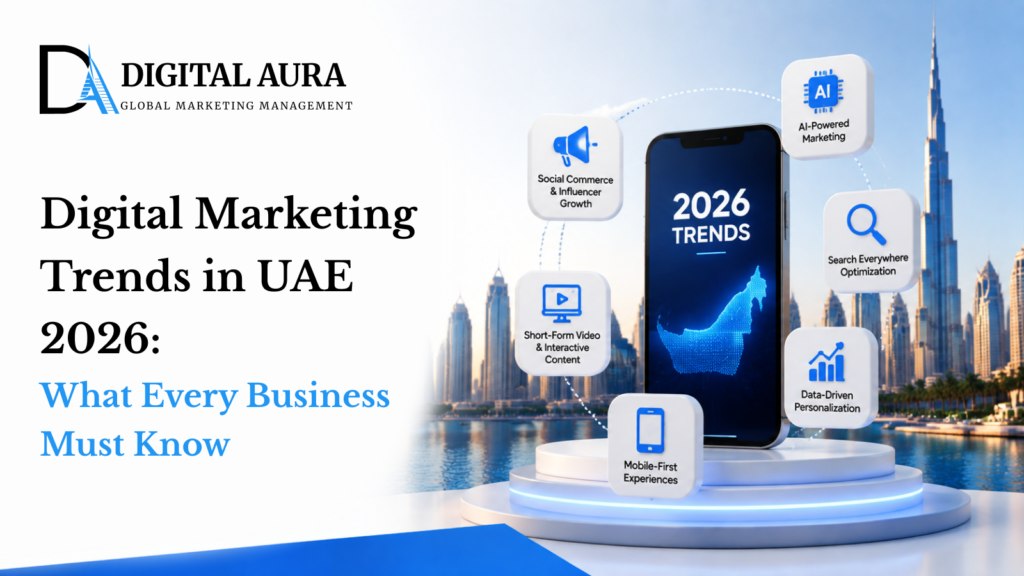
The UAE digital marketing landscape isn’t just changing — it’s being rebuilt from the ground up. AI-powered search, WhatsApp commerce, Arabic-first content, and social storefronts are no longer emerging concepts. In 2026, they are the operating reality for every brand competing in Dubai, Abu Dhabi, and across the Emirates.
This guide draws on the latest market data, platform statistics, and our direct experience managing digital marketing campaigns for clients across the UAE. Whether you’re an SME owner reviewing your strategy, a marketing manager planning next quarter’s budget, or an enterprise brand preparing for structural change — this is the clearest picture available of where UAE digital marketing stands today and where it’s heading.
📌 What This Guide Covers
We break down 7 major digital marketing trends reshaping the UAE in 2026: AI-powered search and GEO, the WhatsApp commerce revolution, Arabic-first content and local SEO, social commerce via TikTok and Instagram, performance marketing with first-party data, video-first content strategy, and UAE data privacy compliance. Each trend includes specific, actionable steps for your business.
The scale of this opportunity is significant. But raw market size doesn’t translate to results — strategy does. Let’s examine each trend in detail, starting with the structural shift that is rewriting the rules of search itself.
1. AI-Powered Search and Generative Engine Optimisation (GEO) Most Critical
The most consequential shift in UAE digital marketing right now is happening in search — and most businesses haven’t adapted yet. High-intent buyers in Dubai are no longer scrolling through pages of blue links. They’re asking AI assistants for direct recommendations and acting on the responses they receive.
Google’s AI Overviews now appear on the majority of commercial searches. ChatGPT reached 300 million active users globally by early 2026. Perplexity.ai has become a default research tool for professionals across the GCC. For UAE businesses, this creates both risk and opportunity: if your website isn’t structured to be understood and cited by these AI systems, you’re invisible to an expanding segment of your potential customers.
What is Generative Engine Optimisation (GEO)?
GEO is the practice of structuring your website — its content, HTML semantics, schema markup, and authority signals — so that AI-powered search engines can find, comprehend, and cite it in their generated responses. It complements traditional SEO rather than replacing it, but requires a different set of optimisations.
Structure Content Around Questions, Not Just Keywords
AI engines are built to answer questions. Your content must too. Use H2 and H3 headings that mirror the exact natural-language questions your UAE audience types and speaks. Direct answers should appear within the first 50 words under each heading — don’t bury them in paragraphs.
Implement FAQPage and HowTo Schema Markup
Structured data is the primary language AI search systems use to parse and categorise your content. Adding FAQPage schema to every key service page and blog post gives Google AI Overviews, ChatGPT with search, and Perplexity the signals they need to represent your brand accurately in AI-generated responses.
Publish Original Data, Case Studies, and Expert Commentary
AI systems prioritise sourcing content that cannot be found elsewhere. Generic, aggregated blog posts rarely get cited. Content with proprietary campaign data, real client outcomes, and expert analysis builds the authority signals that AI engines look for. This is where genuine E-E-A-T (Experience, Expertise, Authoritativeness, Trustworthiness) pays off.
Monitor Your Brand’s AI Presence Actively
Test how AI tools represent your brand today. Search your services and category on ChatGPT, Perplexity, and Google AI Overviews. Ask: “What are the best digital marketing agencies in Dubai?” If your brand isn’t appearing, your content architecture needs adjustment. This is an ongoing discipline, not a one-time audit.
Content with original insights, proprietary data, and real case studies is consistently outperforming generic content in UAE search results in 2026. Brands that structure their content for GEO are reporting up to 40% more leads from AI-cited content compared to traditionally ranked pages. The gap will widen as AI search adoption grows.
2. WhatsApp as a Primary Commerce and Marketing Channel UAE-Specific
No other market in the world looks quite like the UAE when it comes to WhatsApp. With over 90% penetration among UAE adults, WhatsApp isn’t just a messaging app here — it’s the infrastructure through which a significant portion of B2C business actually moves. In 2026, brands that aren’t using WhatsApp Business API as an active sales and marketing channel are leaving revenue on the table.
The UAE consumer’s journey now typically follows a clear pattern: they discover your brand on YouTube or Instagram, validate you on Google Search, and close on WhatsApp. Brands that optimise for this full path — including the WhatsApp endpoint — consistently outperform those that rely solely on website conversions.
How UAE Brands Are Using WhatsApp Business API in 2026
- Direct-to-WhatsApp ad routing: Running Facebook and Instagram ads with “Send WhatsApp Message” CTAs reduces cost per acquisition by up to 40% in tested UAE campaigns, according to performance data from digital marketing agencies operating across the Emirates.
- Personalised product catalogues: WhatsApp Business API allows brands to send interactive catalogues directly into customer conversations, enabling browsing and inquiry without any app switching.
- Automated lead qualification: AI-powered WhatsApp chatbots handle initial inquiries, qualify leads by service type, budget, and timeline, then route high-intent contacts directly to sales teams — all within the app.
- Post-purchase communication: Order confirmations, delivery updates, and re-engagement offers sent via WhatsApp achieve significantly higher open rates than email in the UAE market.
If you’re running paid social campaigns in the UAE and not testing Click-to-WhatsApp as a conversion destination alongside your website landing pages, start today. The reduction in friction — users don’t have to fill forms, they simply initiate a conversation — makes this one of the highest-ROI ad formats available in the UAE market right now.
3. Arabic-First Content and Hyper-Local SEO Growing Fast
For years, digital marketing in the UAE was built predominantly in English. That model is breaking down — and the data is unambiguous about why. Arabic-language search queries in the UAE convert at a significantly higher rate than English across a wide range of categories: local services, real estate, food and beverage, healthcare, retail, and government-adjacent services.
In 2023, approximately 30% of UAE businesses were prioritising Arabic SEO. By 2026, that figure is projected to exceed 50% — meaning the brands that move now still have a window to build a meaningful first-mover advantage before the space becomes as competitive as English-language search.
What Arabic-First Digital Marketing Actually Requires
The most common mistake UAE brands make is treating Arabic content as a translation exercise. Genuine Arabic-first SEO requires something different: content that reflects the linguistic patterns, cultural references, and search behaviour of Arabic-speaking UAE consumers. This includes meaningful differences in vocabulary between Emirati, Egyptian, and Levantine Arabic speakers — all of whom form significant segments of the UAE population.
Create Original Arabic Content, Not Just Translations
Arabic SEO requires pages built from the ground up in Arabic, using the search terms and conversational patterns Arabic speakers actually use. Direct translations of English copy rarely match the keyword intent or phrasing of organic Arabic searches. Work with native Arabic copywriters who understand your sector.
Optimise Google Business Profile for Arabic Audiences
Your Google Business Profile should include an Arabic business description and Arabic responses to reviews. Service categories should be verified against what Arabic-speaking users actually search for in your area. This is a high-impact change that most businesses in Dubai have not yet made.
Target Hyper-Local Arabic Keywords by Emirate
Search behaviour differs meaningfully between Dubai, Abu Dhabi, Sharjah, and other Emirates — in both language style and purchase intent. “خدمات تسويق رقمي في دبي” and “أفضل وكالة سيو في أبوظبي” are different market segments that require different content strategies, not one-size-fits-all Arabic pages.
Use hreflang Tags to Signal Language Targeting Correctly
If you’re running parallel Arabic and English versions of your site, correct hreflang implementation is essential. Errors here cause both versions to compete against each other in search results rather than capturing their respective audiences. This is one of the most common technical SEO mistakes we see on UAE business websites.
4. Social Commerce: TikTok, Instagram, and the Social Storefront High Growth
The distinction between social media platform and e-commerce storefront has effectively collapsed in the UAE. TikTok Shop launched in the UAE in 2024 and by 2026 had become a primary sales channel for beauty, fashion, electronics, and consumer goods brands. Instagram Shopping and Snapchat’s native commerce features have similarly matured from awareness tools into genuine revenue channels.
The underlying shift is profound: UAE consumers — particularly under 35 — are no longer visiting brand websites to discover products. They are discovering, evaluating, and purchasing within the social app, without ever leaving. Brands that treat social platforms exclusively as traffic sources to their website are losing sales to competitors who have built native social storefronts.
The UAE Social Media Landscape in 2026: Platform by Platform
| Platform | UAE Reach | Best Use Case | Commerce Features |
|---|---|---|---|
| 9.70M users | Paid advertising, retargeting, older demographics | Facebook Shops, Marketplace, WhatsApp routing | |
| YouTube | 8.37M users | Long-form video, brand authority, search integration | Shopping integrations, product pins |
| 10M+ members | B2B marketing, professional services, recruitment | Lead Gen Forms, sponsored content | |
| High penetration under-40 | Brand visual identity, product discovery, influencer | Instagram Shopping, Reels with product tags | |
| TikTok | Dominant under-35 | Product discovery, UGC, live shopping events | TikTok Shop, live commerce, shoppable video |
| Snapchat | Strong in youth demographics | AR campaigns, younger consumer brands | Dynamic Product Ads, AR try-on |
Live Commerce: The Channel UAE Brands Are Underusing
Live shopping events — where brands and influencers demonstrate products in real time, answer questions, and drive immediate purchases — are mainstream in China and rapidly gaining ground in the UAE. For categories like beauty, fashion, food, and electronics, live commerce events on TikTok and Instagram consistently generate conversion rates that outperform standard product pages by a significant margin.
The UAE’s National Media Council requires all paid partnerships and sponsored content to be disclosed clearly. In 2026, the Advertiser Permit system has introduced greater accountability for influencer marketing campaigns. All paid collaborations must be labelled accurately. Work with an agency that understands and builds compliance into influencer campaign structures from the start.
5. Performance Marketing and First-Party Data Strategy Evolving Fast
UAE businesses are moving rapidly away from “spray and pray” digital advertising toward tightly measured performance marketing — and the shift is driven by both necessity and opportunity. The UAE’s Personal Data Protection Law (PDPL) came into force in 2025, introducing meaningful constraints on third-party cookie-based tracking. Simultaneously, programmatic advertising and AI-driven bidding have matured to a point where brands running first-party data strategies are seeing measurably better returns than those relying on platform audiences alone.
The businesses that will dominate UAE digital advertising through 2026 and beyond are building owned data assets: CRM databases, email lists, WhatsApp subscriber bases, and loyalty programme data that don’t depend on third-party tracking infrastructure.
Building a First-Party Data Strategy for UAE Campaigns
Audit Your Current Data Collection Points
Map every point where your brand collects customer data: website forms, WhatsApp inquiries, checkout flows, CRM integrations, loyalty programmes, and event registrations. Most UAE businesses are collecting far less first-party data than they could be — and what they do collect isn’t being structured for retargeting and lookalike audience creation.
Implement Conversion APIs Alongside Pixel Tracking
Meta’s Conversions API and Google’s Enhanced Conversions allow you to pass first-party event data server-side to advertising platforms, bypassing browser-level tracking limitations. In the post-cookie environment, this is essential for accurate attribution and bid optimisation on UAE campaigns.
Build and Segment Your CRM as a Marketing Asset
Your CRM isn’t just a sales tool — it’s the foundation of your performance marketing capability. Segmented CRM data uploaded as custom audiences to Meta and Google consistently outperforms cold interest-based targeting for UAE campaigns, particularly for high-ticket services where intent signals matter more than demographics.
Move Beyond CTR: Measure Customer Lifetime Value
The leading UAE brands in 2026 are shifting their performance marketing KPIs from click-through rates and cost-per-click toward customer lifetime value, revenue attribution, and return on ad spend calculated against actual CRM outcomes. This shift requires connecting your ad platforms to your CRM — but it produces dramatically more accountable marketing spend.
6. Video-First Content Strategy: Beyond Short-Form
Video content dominance in the UAE is established fact, not emerging trend. YouTube reaches 8.37 million UAE users. TikTok commands the attention of under-35 audiences. Instagram Reels outperforms static posts across virtually every engagement metric. The question for UAE brands in 2026 is no longer whether to invest in video — it’s how to build a video strategy that serves multiple objectives simultaneously.
The most effective UAE brands in 2026 use video across the full marketing funnel, with different formats serving different roles. Short-form video (15–60 seconds) drives discovery and top-of-funnel awareness. Mid-length explainer content (2–5 minutes) builds authority and consideration. Long-form YouTube content and webinars convert high-intent audiences and support SEO.
Video Content Opportunities That UAE Brands Are Underusing
- Arabic-language video: The majority of UAE brands still produce video content primarily in English. High-quality Arabic video content represents a genuine competitive gap — particularly for local services, retail, healthcare, and real estate categories where Arabic-speaking audiences are the primary buyers.
- Ramadan and UAE cultural calendar content: Emotionally resonant campaigns tied to Ramadan, Eid, National Day, and other culturally significant moments consistently generate above-average engagement and brand recall in the UAE. Most brands produce this content reactively — planning it 6–8 weeks in advance dramatically improves quality.
- Proof-of-work and behind-the-scenes video: For service businesses in Dubai — agencies, consultancies, professional services, contractors — video that shows actual work being done builds trust faster than any other format. Client testimonials filmed on location, process walkthroughs, and team expertise demonstrations convert consideration into inquiry.
- AR-enhanced video and interactive content: Real estate and fashion brands in the UAE are deploying augmented reality video — virtual property tours, AR try-on for watches and eyewear, interactive product demonstrations — with measurable impact on conversion rates and time-on-site.
Video and SEO: Video embedded within blog posts and service pages improves engagement signals that Google factors into organic ranking — specifically dwell time, scroll depth, and return visit rates. A video-only social strategy misses the compounding SEO benefit of embedding relevant video within your website content.
7. UAE Data Privacy Compliance as a Marketing Advantage
The UAE’s Personal Data Protection Law (PDPL) came into force in 2025, and its implications for digital marketing are still being absorbed across the industry. Most businesses are treating PDPL compliance as a legal obligation to be managed — the smarter brands are treating it as a competitive differentiator.
UAE consumers, like consumers globally, are increasingly aware of how their data is collected and used. Brands that communicate clearly about data practices, use transparent cookie consent mechanisms, and demonstrate genuine respect for user privacy are building the kind of trust that drives long-term customer value — particularly in categories like healthcare, financial services, and high-ticket retail where trust is a primary purchase driver.
What PDPL Compliance Requires for Digital Marketing Teams
- Cookie consent: Your website must implement a genuine opt-in consent mechanism — pre-ticked boxes don’t meet the standard. Users must actively consent to non-essential cookies before tracking begins.
- Data processing transparency: Privacy policies must clearly explain what data you collect, how it’s used, who it’s shared with, and how users can request deletion.
- Email and WhatsApp marketing consent: Sending marketing communications requires documented, explicit consent. Purchased lists and assumed consent from business card exchange are not sufficient.
- Third-party vendor audits: If your CRM, email platform, or ad tech stack shares data with third parties, you are responsible for ensuring those third parties also comply with PDPL requirements.
PDPL penalties for data protection breaches in the UAE can reach AED 5 million for serious violations. Beyond the financial risk, a data breach or privacy scandal creates reputational damage that is extremely difficult to recover from in the UAE’s relationship-driven business culture. If you haven’t conducted a marketing data audit since PDPL came into force, do it before your next major campaign.
The 2026 UAE Digital Marketing Landscape: At a Glance
AI Search & GEO
Structure content for AI citation. FAQPage schema, original data, and semantic HTML are the primary GEO signals.
WhatsApp Commerce
90%+ UAE penetration. Direct-to-WhatsApp ad routing cuts CPA by up to 40%. Build the full WhatsApp funnel.
Arabic-First Content
Arabic queries convert higher. 50%+ of UAE businesses now prioritise Arabic SEO. First movers still have an edge.
Social Commerce
TikTok Shop is now a primary sales channel. Build native storefronts on TikTok, Instagram, and Snapchat.
First-Party Data
Post-PDPL, owned data assets outperform third-party audiences. Build CRM as a marketing capability, not just a sales tool.
Video-First Strategy
Arabic video, live commerce, and proof-of-work content are the underdeveloped opportunities in UAE video marketing.
We are a Dubai-based digital marketing agency specialising in SEO, paid media, social media marketing, web development, and content strategy for businesses across the UAE and internationally. Our team works hands-on across every channel — from technical SEO audits and Google Ads campaign management to Shopify development and Arabic content creation. The trends and data in this guide are informed by our direct experience managing campaigns for clients across real estate, e-commerce, healthcare, hospitality, and professional services in the UAE.
Frequently Asked Questions
What are the top digital marketing trends in the UAE for 2026?
The top digital marketing trends in the UAE for 2026 are: AI-powered search and Generative Engine Optimisation (GEO), WhatsApp as a primary commerce channel, Arabic-first content and local SEO, social commerce via TikTok Shop and Instagram Shopping, performance marketing with first-party data strategy, video-first content, and UAE data privacy compliance under PDPL. UAE digital ad spend is forecast to reach US$2.64 billion in 2026, growing at 17.7% CAGR through 2029.
How big is the digital marketing market in the UAE in 2026?
UAE digital advertising spend is forecast to reach US$2.64 billion in 2026, according to Statista, representing a compound annual growth rate of 17.7% through 2029. The UAE has over 11 million internet users, 99% internet penetration, and more than 21 million mobile connections — making it one of the most digitally advanced and competitive advertising markets in the Middle East.
What is Generative Engine Optimisation (GEO) and why does it matter for UAE businesses?
Generative Engine Optimisation (GEO) is the practice of structuring your website content so that AI search tools — like Google AI Overviews, ChatGPT with search, and Perplexity — can find, understand, and cite it in their generated responses. In the UAE, where high-income and tech-savvy buyers increasingly use AI assistants instead of traditional search, GEO is a critical visibility channel. It requires question-based content structure, FAQPage schema markup, and original authoritative content that AI engines prefer to reference.
Is Arabic SEO worth investing in for businesses in Dubai?
Yes — significantly. Arabic-language search queries convert at a higher rate than English for many product and service categories in the UAE, including local services, real estate, healthcare, and retail. More than 50% of UAE businesses are now prioritising Arabic SEO in 2026, up from 30% in 2023. The brands that invest in genuine Arabic content — created natively for Arabic-speaking audiences, not just translated from English — gain a meaningful competitive advantage that compounds over time.
How should UAE businesses use WhatsApp for digital marketing?
WhatsApp has over 90% penetration among UAE adults. In 2026, effective WhatsApp marketing uses the Business API to route leads directly from paid social ads into WhatsApp conversations (reducing CPA by up to 40% in tested campaigns), to send personalised product catalogues, to automate initial lead qualification, and to manage post-purchase communication. WhatsApp is where the UAE consumer closes — brands must optimise for this endpoint in their marketing funnel.
What does UAE PDPL mean for digital marketing teams?
The UAE Personal Data Protection Law (PDPL), which came into force in 2025, requires businesses to obtain explicit, documented user consent before collecting and using personal data for marketing. This affects cookie tracking on websites, email marketing, WhatsApp broadcast lists, and third-party data sharing with ad platforms. Marketing teams must implement genuine opt-in consent mechanisms, maintain clear privacy policies, and audit their ad tech stack for PDPL compliance. Non-compliance carries financial penalties of up to AED 5 million.
What to Prioritise: A Practical Action Plan for UAE Businesses
Not every business can tackle all seven trends simultaneously. Based on our experience working with clients across the UAE, here is a prioritisation framework based on business type:
For service businesses (professional services, agencies, consultancies, healthcare): Start with GEO and local SEO. Structure your service pages for AI citation, implement FAQPage schema, and build your Google Business Profile as a genuine authority asset. WhatsApp lead routing is your second priority — it compresses the sales cycle significantly in the UAE B2B context.
For e-commerce and retail brands: Social commerce infrastructure should be your first investment — building native TikTok Shop and Instagram Shopping storefronts, and creating shoppable video content in both English and Arabic. WhatsApp order and post-purchase communication compounds the value of every customer acquired.
For hospitality, real estate, and high-ticket categories: Video-first content — particularly Arabic-language video and virtual/AR experiences — combined with a first-party data strategy built around CRM and Custom Audience campaigns will deliver the strongest returns. These categories depend on trust-building before purchase, and immersive content is the most efficient trust accelerator available.
- Audit your site for GEO readiness: question-based headings, FAQPage schema, semantic HTML
- Set up WhatsApp Business API and test Click-to-WhatsApp ad campaigns
- Build or commission genuine Arabic-language content for your top service pages
- Set up native storefronts on TikTok Shop and Instagram Shopping
- Implement server-side Conversions API to maintain attribution post-PDPL
- Review and document your data collection practices for PDPL compliance
- Monitor your brand’s presence on ChatGPT, Perplexity, and Google AI Overviews monthly
Ready to Build a 2026-Ready Digital Marketing Strategy?
Digital Aura Marketing works with businesses across Dubai and the UAE to build integrated digital strategies that perform in both traditional and AI-powered search environments — from technical SEO and Google Ads to Arabic content, WhatsApp marketing, and social commerce.
If you’d like an honest assessment of where your current digital marketing stands against the trends above, start with a free strategy consultation.