

Quick Answer
WordPress fits UAE businesses that need full SEO control, custom functionality, and content-heavy marketing, such as service providers, real estate developers, clinics, and B2B companies.
Shopify fits UAE businesses selling physical products online who want a faster launch, built-in payment and inventory tools, and less ongoing technical maintenance. Many growing UAE brands end up using both: WordPress for the marketing site and blog, Shopify for the storefront.
There is no single winner. The right platform depends on whether your business runs on content and leads, or on product sales and checkout volume.
Why This Decision Matters More in the UAE Than Elsewhere
Picking a website platform is rarely just a technical choice, and in the UAE it carries a few extra layers that businesses in other markets don’t have to think about.
First, VAT. Every invoice your website generates, whether it’s a Shopify order confirmation or a WooCommerce receipt, needs to reflect the UAE’s 5% VAT correctly.
Second, e-invoicing. The Federal Tax Authority is rolling out a mandatory e-invoicing system in phases: a voluntary pilot from July 2026, mandatory compliance for businesses earning AED 50 million or more from January 2027, and a wider rollout for smaller businesses and government entities through 2027.
Once a business is in scope, PDF invoices and emailed receipts no longer count. Invoices need to be issued in structured formats and routed through an FTA-accredited service provider. This affects how your ecommerce backend needs to be built, and it’s a factor most UAE businesses aren’t yet weighing when they choose a platform.
Third, local payment behavior. UAE shoppers expect Apple Pay, cards issued by regional banks, and increasingly WhatsApp-based ordering. Not every platform handles regional payment gateways like Telr, PayTabs, or Network International equally well out of the box.
Fourth, bilingual content. A large share of the UAE audience searches and browses in Arabic, and Google treats Arabic and English versions of a page as separate ranking opportunities. Your platform needs to handle this cleanly, not as an afterthought.
These four factors, more than raw feature comparisons, tend to decide which platform is actually the right fit for a UAE business.
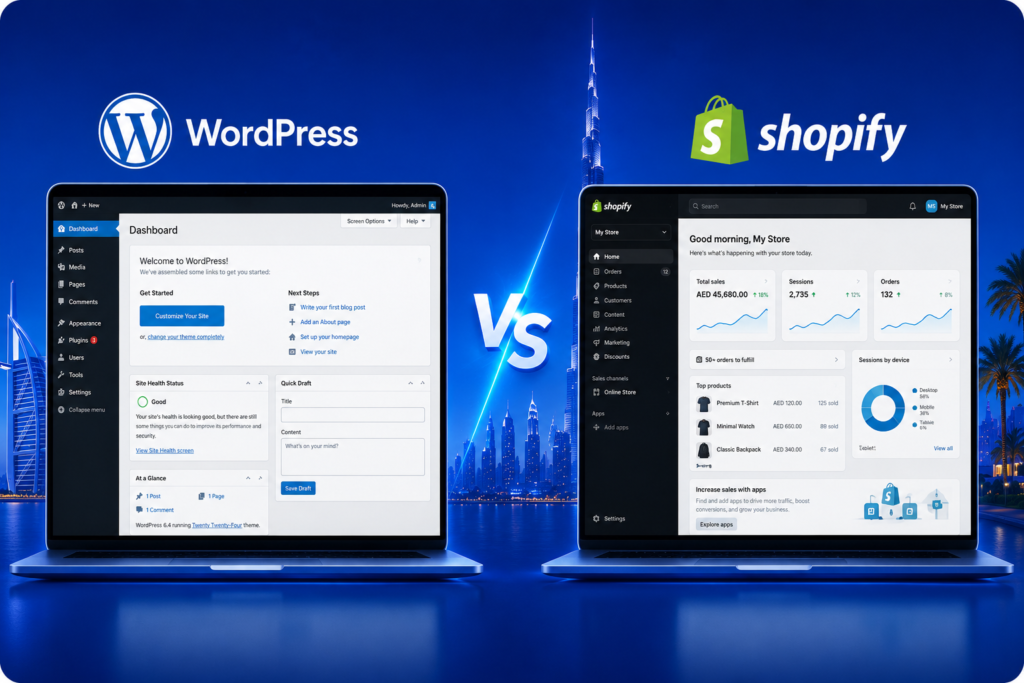
WordPress vs Shopify: The Core Difference
WordPress is an open-source content management system. It now powers over 40% of all websites worldwide, more than every other CMS combined, largely because it can be shaped into almost anything: a blog, a lead-generation site, a directory, a booking system, or (with WooCommerce added) a full online store. You own the code, the hosting, and the data outright.
Shopify is a hosted ecommerce platform. You don’t manage servers, security patches, or backups; Shopify handles all of that. In exchange, you build inside Shopify’s structure using its themes and app ecosystem rather than writing custom code from scratch. It’s built from the ground up for one job: selling products online, and it does that job well.
That’s the real fork in the road. WordPress is a flexible foundation you build on. Shopify is a specialized tool you plug into.
Detailed Comparison
1. Setup Speed and Technical Maintenance
Shopify stores can go live in days. Hosting, security patching, and uptime are Shopify’s responsibility, not yours.
WordPress takes longer to set up properly. You, or your developer, choose hosting, install security plugins, manage updates, and configure backups. This gives you more control but means someone needs to own that maintenance long term, either in-house or through an agency retainer.
Faster to launch: Shopify
More control over the stack: WordPress
2. Cost in the UAE Market
Shopify runs on a monthly subscription (roughly $39 to $399+ depending on the plan), plus transaction fees if you don’t use Shopify Payments, plus paid apps for anything beyond the basics. Shopify Payments isn’t natively available in the UAE, so most UAE merchants connect a third-party gateway like Telr, PayTabs, or Network International, which usually adds its own processing fees on top of the subscription.
WordPress itself is free, but “free” is misleading. You’re paying for hosting, a premium theme, a page builder, essential plugins, and either developer time or an agency retainer. For a content-first or lead-gen site, WordPress is often cheaper over 2 to 3 years. For a product-heavy store, Shopify’s all-in-one pricing can work out more predictable, even if the sticker price looks higher month to month.
3. SEO and Content Marketing
This is where the two platforms diverge the most, and it’s the area we spend the most time in with clients.
WordPress gives you granular control over URL structure, internal linking, schema markup, page speed optimization at the code level, and content types. If your growth strategy depends on ranking for competitive terms, publishing long-form guides, or building topic clusters (the kind of structure that also helps you get cited in AI Overviews and tools like ChatGPT and Perplexity), WordPress gives you the flexibility to execute that properly.
Shopify’s built-in SEO has improved a lot, but it still has real limitations: URL structures for collections and blogs are partially fixed, and deeper technical customization often requires app workarounds rather than direct control.
Better for SEO-led, content-heavy growth: WordPress
Solid enough for product-led SEO: Shopify
If AI-driven search visibility (AEO/GEO) is part of your strategy, this matters even more. Structured, crawlable content with clean markup gives AI answer engines something clear to pull from, and that’s easier to control on WordPress. Our AI SEO services team builds this into every WordPress project we deliver.
4. Ecommerce Capability
Shopify was purpose-built for selling online: checkout, inventory, shipping rules, abandoned cart recovery, and product variants all work out of the box.
WordPress needs WooCommerce (or another plugin) to sell products, and while WooCommerce is genuinely powerful and flexible, it requires more setup and more careful plugin management to run smoothly at scale.
Best out-of-the-box ecommerce: Shopify
Best for complex or unusual product catalogs: WordPress with WooCommerce
5. VAT and E-Invoicing Readiness
Both platforms can be configured to calculate 5% UAE VAT correctly and generate compliant invoices, but the effort differs.
Shopify has built-in tax settings that handle standard VAT calculation reasonably well, though FTA-compliant e-invoicing (structured XML formats routed through an accredited service provider) typically needs a specialized app or integration once your business is in scope.
WordPress with WooCommerce needs specific plugins configured correctly for VAT and, later, for e-invoicing compliance, but because you have full backend access, integrating with an Accredited Service Provider is more straightforward from a development standpoint.
If your revenue is approaching AED 50 million, or you expect to cross that line before 2027, it’s worth discussing e-invoicing readiness with your web developer now rather than after your platform is built.
6. Customization and Scalability
WordPress has effectively no ceiling. With the right development, it scales into headless architecture, custom applications, or hybrid content-plus-commerce builds.
Shopify scales extremely well for pure ecommerce (it handles traffic spikes and high order volumes without you touching server infrastructure) but you’re always working within Shopify’s platform boundaries.
7. Security
Shopify manages security centrally as part of the platform, which is one less thing for a business owner to worry about.
WordPress security depends entirely on how well the site is maintained. A well-managed WordPress site (updated core, vetted plugins, proper hosting) is secure. A neglected one is a common target. This is one of the main reasons agencies offer ongoing WordPress maintenance as a service rather than a one-time build.
Comparison at a Glance
| Factor | WordPress | Shopify |
|---|---|---|
| Setup speed | Slower, more configuration | Fast, launch in days |
| Best for | Content, SEO, lead generation, custom builds | Product sales, online stores |
| Ecommerce | Needs WooCommerce | Built in |
| SEO control | Full, granular | Good, but structurally limited |
| UAE VAT handling | Configurable via plugins | Built-in, needs local gateway |
| Maintenance | Ongoing, your responsibility | Handled by Shopify |
| Cost model | Hosting + theme + plugins + dev time | Monthly subscription + apps + gateway fees |
| Ceiling on customization | Very high | Moderate, app-dependent |
Choose WordPress If
- SEO and organic content are central to your growth strategy
- You run a service business, clinic, real estate brand, or B2B company rather than a product catalog
- You need full customization or a hybrid content-and-commerce site
- You want direct control over technical SEO, schema, and page speed
Choose Shopify If
- You’re selling physical products and want to launch quickly
- You’d rather not manage hosting, security, or backend maintenance
- Your team has limited in-house technical resources
- Product sales, not blog content, will drive most of your traffic
Consider a Hybrid Setup If
Several of our clients run WordPress for the main site, blog, and lead generation, with Shopify handling the storefront separately (or as a subdomain). This works well when content marketing drives traffic and product sales convert it. It takes more planning to keep both platforms aligned on branding, tracking, and SEO, but for content-heavy ecommerce brands it’s often the strongest setup.
Frequently Asked Questions
Is WordPress or Shopify better for SEO in the UAE?
WordPress generally offers more SEO control, including custom URL structures, schema markup, and technical optimization, which matters for competitive UAE keywords. Shopify’s built-in SEO is solid for a straightforward product catalog but has more structural limitations.
Is Shopify legal and fully supported in the UAE?
Yes. Shopify is widely used by UAE ecommerce businesses. Shopify Payments isn’t natively available in the region, so UAE merchants typically connect a local payment gateway such as Telr, PayTabs, or Network International instead.
Can WordPress and Shopify be used together?
Yes. A common hybrid approach uses WordPress for content marketing and lead generation and Shopify for the actual storefront and checkout. This is a good fit for brands where content drives most of the top-of-funnel traffic.
Does my platform choice affect UAE e-invoicing compliance?
It affects how much work compliance takes. Both platforms can be configured for FTA e-invoicing, but WordPress’s open backend generally makes it easier to integrate directly with an Accredited Service Provider. If your revenue is near or above AED 50 million, plan this into your platform decision now, since mandatory compliance is being phased in through 2027.
Which platform costs less to run in the UAE?
For content-led or lead-generation businesses, WordPress is usually cheaper over 2 to 3 years. For product-based businesses, Shopify’s subscription pricing is often more predictable, even though it includes ongoing app and gateway costs.
Is WordPress outdated in 2026?
No. WordPress still powers more than 40% of all websites globally and continues to add capabilities like headless setups and AI-assisted content tools. It remains the more flexible option for businesses that need full control over their site.
Which Platform Should You Choose?
If your growth depends on ranking in search, publishing content, and generating leads, WordPress gives you the control to do that properly. If your growth depends on selling products online with minimal technical overhead, Shopify gets you there faster.
The wrong platform choice doesn’t just limit your website today, it limits how easily you can scale, rank, and stay compliant as your business grows. If you want a second opinion on which platform fits your specific business model, our team can walk through your goals, budget, and growth plan and recommend the right fit rather than a default answer.
Talk to our web design team or get a free digital strategy audit.