Pay-per-click advertising has become one of the most effective digital marketing channels for businesses worldwide. Whether you’re a small startup or an established enterprise, understanding PPC marketing can transform your online visibility and drive measurable results.
This comprehensive guide covers everything you need to know about PPC advertising—from fundamental concepts to advanced strategies that deliver real ROI.
📌 Quick Summary
PPC (pay-per-click) marketing is a digital advertising model where advertisers pay a fee each time someone clicks their ad. Unlike organic marketing, PPC delivers immediate visibility on search engines, social media platforms, and websites. Advertisers bid on keywords relevant to their target audience, and ads appear in prominent positions when users search for those terms. With proper strategy, PPC generates an average ROI of $2 for every $1 spent.
What is PPC Marketing?
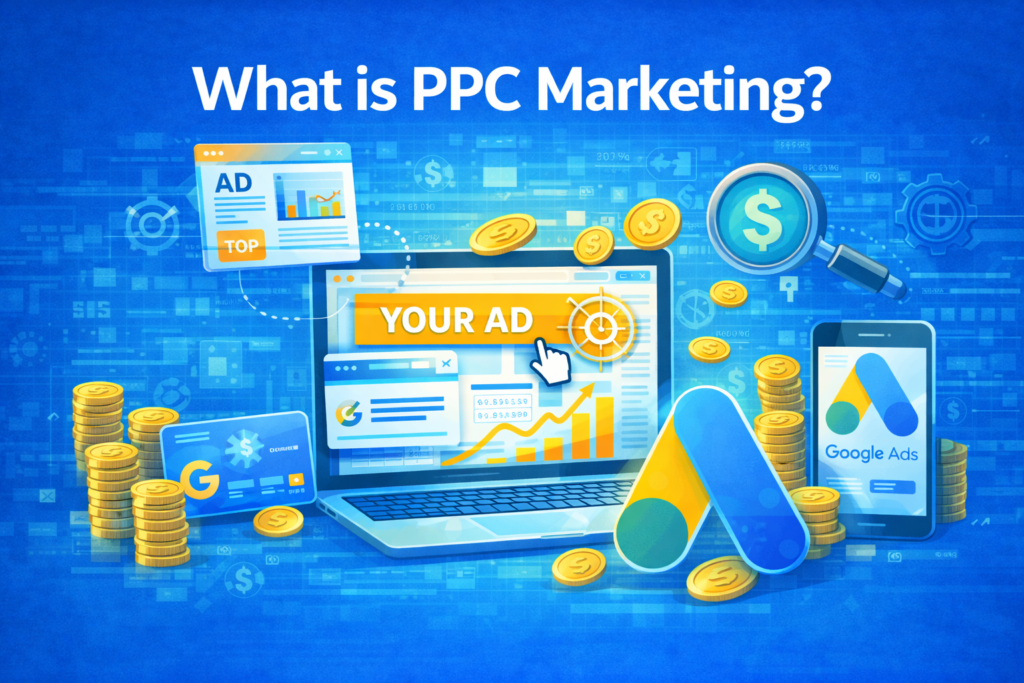
PPC (pay-per-click) marketing is an online advertising model where businesses pay publishers only when users click on their advertisements. Advertisers compete in real-time auctions, bidding on keywords, audience segments, and ad placements across various digital platforms.
Also known as cost-per-click (CPC) advertising, PPC is the foundation of search engine marketing on platforms like Google Ads and Microsoft Advertising. Social media networks including Facebook, Instagram, TikTok, and LinkedIn also operate on PPC models.
Here’s what makes PPC unique:
- Immediate visibility: Your ads can appear within hours of campaign launch
- Precise targeting: Reach specific demographics, locations, and interests
- Budget control: Set daily or monthly spending limits
- Performance tracking: Measure clicks, conversions, and ROI in real-time
- Scalability: Adjust campaigns based on performance data
The core principle is simple: you only pay when someone actively engages with your ad by clicking it, making PPC one of the most cost-efficient advertising methods available.
How Does PPC Advertising Work?
PPC advertising operates through a sophisticated auction system that determines which ads appear and in what order. Understanding this process helps you create more effective campaigns.
The PPC Auction Process
Keyword Selection and Bidding
Advertisers select relevant keywords and phrases their target audience searches for. For each keyword, they set a maximum bid—the highest amount they’re willing to pay per click.
Ad Creation
Businesses create compelling ad copy with headlines, descriptions, and call-to-action buttons designed to attract clicks from qualified prospects.
Quality Score Evaluation
Search engines evaluate your Quality Score based on ad relevance, landing page experience, expected click-through rate, and ad format impact.
Ad Rank Calculation
Your Ad Rank = Maximum Bid × Quality Score. This formula determines your ad position. A lower bid with higher quality can outrank a higher bid with poor quality.
Ad Display and Charging
When users search for your targeted keywords, the auction runs instantly. Winning ads appear in prominent positions, and you’re charged only when someone clicks.
Where PPC ads appear – Digital Aura Marketing
Where PPC Ads Appear
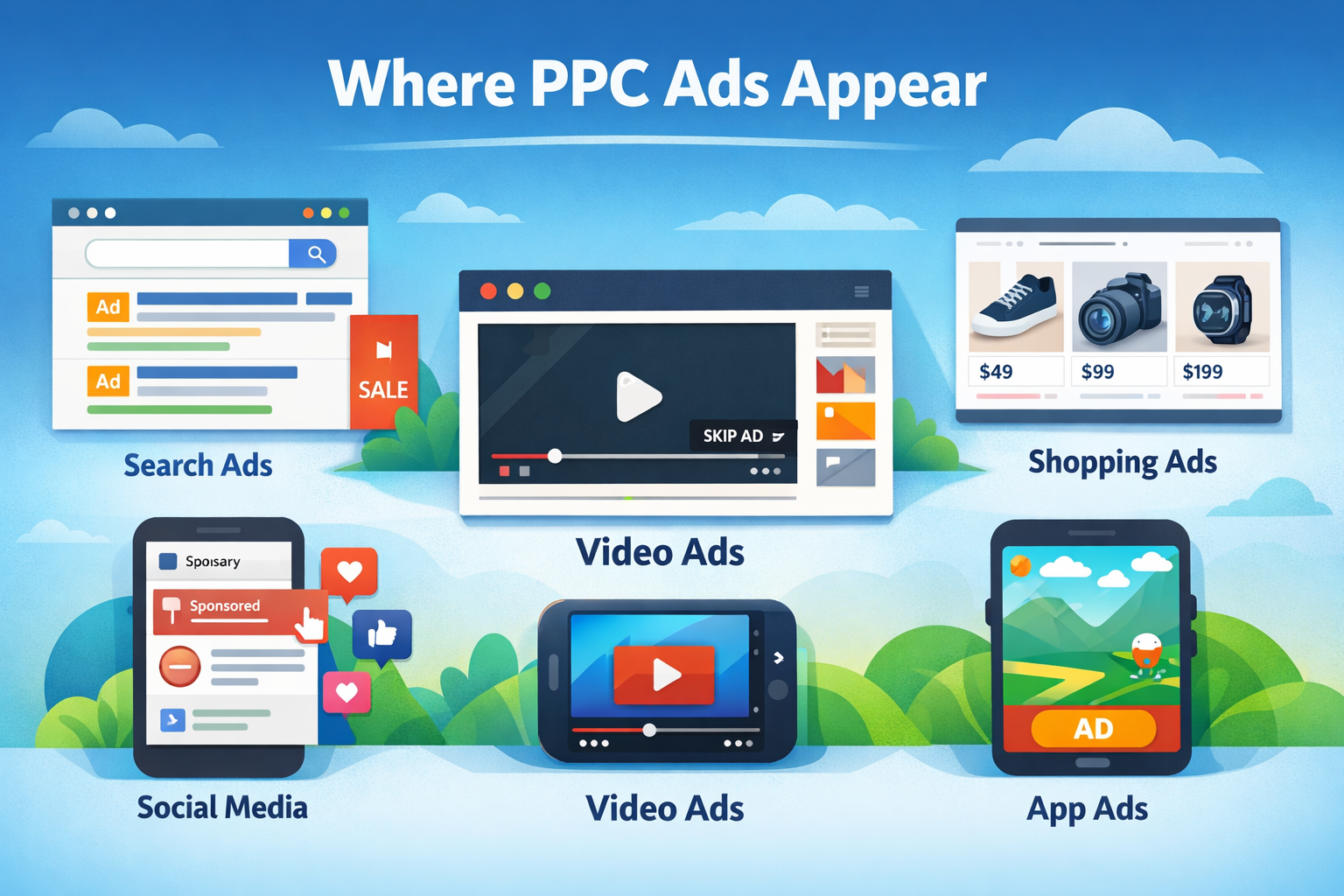
PPC advertisements display across multiple channels:
- Search engine results pages (SERPs): Above and below organic listings
- Display networks: Banner ads on partner websites
- Social media feeds: Sponsored posts on Facebook, Instagram, LinkedIn
- Video platforms: Pre-roll and mid-roll ads on YouTube
- Shopping platforms: Product listings with images and prices
- Mobile apps: In-app advertising spaces
Why is PPC Marketing Important for Your Business?
PPC advertising shouldn’t be viewed as a marketing expense—it’s a strategic investment that delivers measurable returns. Here’s why businesses of all sizes rely on PPC:
Immediate Traffic and Results
Unlike SEO, which takes months to show results, PPC drives targeted traffic within hours. Launch a campaign in the morning, and you could be generating leads by afternoon. This speed makes PPC invaluable for:
- New product launches
- Seasonal promotions
- Event marketing
- Business launches needing instant visibility
Precise Audience Targeting
PPC platforms offer granular targeting options that reach your ideal customers:
- Demographics: Age, gender, income level, education
- Geographic location: Countries, cities, zip codes, or radius targeting
- Interests and behaviors: Shopping habits, hobbies, online activity
- Device type: Desktop, mobile, tablet-specific campaigns
- Time of day: Show ads when your audience is most active
- Remarketing: Re-engage visitors who previously interacted with your brand
Measurable ROI and Performance
Every aspect of PPC is trackable and measurable:
- Impressions (how often ads are shown)
- Click-through rates (CTR)
- Conversion rates
- Cost per acquisition (CPA)
- Return on ad spend (ROAS)
- Customer lifetime value
Analytics platforms like Google Analytics integrate seamlessly with PPC campaigns, providing detailed insights into user behavior and conversion paths.
Cost-Effectiveness and Budget Control
You maintain complete control over spending:
- Set daily budgets to prevent overspending
- Pause campaigns instantly if needed
- Allocate more budget to high-performing campaigns
- Test small budgets before scaling
Complementary to SEO Strategy
PPC and SEO work better together than separately. While building organic rankings through SEO, PPC provides immediate visibility for competitive keywords. Use PPC data to:
- Identify high-converting keywords for SEO focus
- Test messaging before committing to content creation
- Dominate search results by appearing in both paid and organic listings
- Maintain visibility during algorithm updates
PPC vs SEM vs SEO: Understanding the Differences
These terms are often confused, but they represent distinct marketing approaches. Understanding the differences helps you build comprehensive digital strategies.
Search Engine Marketing (SEM)
SEM is the umbrella term encompassing all marketing activities designed to increase visibility in search engine results. SEM includes both paid and organic tactics:
- Paid search advertising (PPC)
- Search engine optimization (SEO)
- Local search optimization
- Shopping campaigns
Think of SEM as the complete strategy, with PPC and SEO as specific tactics within it.
Direct Comparison Table
| Factor | PPC | SEO |
|---|---|---|
| Results Timeline | Hours to days | Months to years |
| Cost Structure | Pay per click | Time and content investment |
| Sustainability | Stops when budget ends | Long-term traffic source |
| Best For | Product launches, promotions, testing | Brand building, long-term growth |
| Targeting Precision | Extremely precise | Broad keyword targeting |
| Click Costs | Varies by competition | Free (after ranking) |
Recommendation: Start with PPC for immediate results while building SEO for long-term sustainability. Use PPC data to inform SEO strategy.
Top PPC Advertising Platforms in 2026
Choosing the right platform depends on your audience, budget, and business objectives. Here are the leading PPC platforms:
Google Ads
Market Share: Google processes over 99,000 searches per second, making Google Ads the largest PPC platform globally.
Best For: Businesses of all sizes, high-intent keywords, B2B and B2C companies, local and global campaigns.
Ad Types: Search ads, Display ads, Shopping ads, Video ads (YouTube), App promotion, Performance Max.
Microsoft Advertising
Market Share: Powers search ads on Bing, Yahoo, and partner sites.
Best For: B2B companies, Enterprise solutions, Professional services, Desktop users.
Key Advantage: Lower competition = 30-50% cheaper CPCs than Google. Easy import of Google Ads campaigns.
Facebook Ads (Meta)
Reach: Over 2.9 billion monthly active users across Facebook and Instagram.
Best For: E-commerce businesses, Brand awareness campaigns, Visual products, B2C marketing.
Ad Formats: Image ads, Video ads, Carousel ads, Collection ads, Stories ads, Messenger ads.
Instagram Ads
Audience: Over 2 billion monthly users, predominantly 18-34 age range.
Best For: Visual brands (fashion, beauty, food, travel), Influencer partnerships, E-commerce with strong imagery.
Key Benefit: Seamless integration with Facebook Ads Manager for unified campaign management.
LinkedIn Ads
Audience: 900+ million professionals, decision-makers, and business leaders.
Best For: B2B marketing, Professional services, SaaS companies, Recruitment, Thought leadership.
Targeting: Job title, company size, industry, seniority level, professional skills.
YouTube Ads
Reach: 2+ billion logged-in users monthly, second-largest search engine.
Best For: Video content marketers, Brand storytelling, Product demonstrations, Tutorial content.
Ad Formats: Skippable in-stream, Non-skippable in-stream, Bumper ads, Video discovery ads.
TikTok Ads
Growth: Fastest-growing social platform with 1+ billion monthly users.
Best For: Youth marketing (Gen Z focus), Viral campaign potential, Creative authentic content, Product launches.
Ad Formats: In-feed ads, Brand takeover, TopView, Branded hashtag challenges, Branded effects.
Twitter (X) Ads
Best For: Real-time marketing, News and media companies, Tech companies, Thought leadership, Event promotion.
Ad Types: Promoted tweets, Promoted accounts, Promoted trends, Website cards, App install cards.
Types of PPC Ads: Formats and Strategies
Different ad formats serve different marketing objectives. Understanding each type helps you choose the right approach.
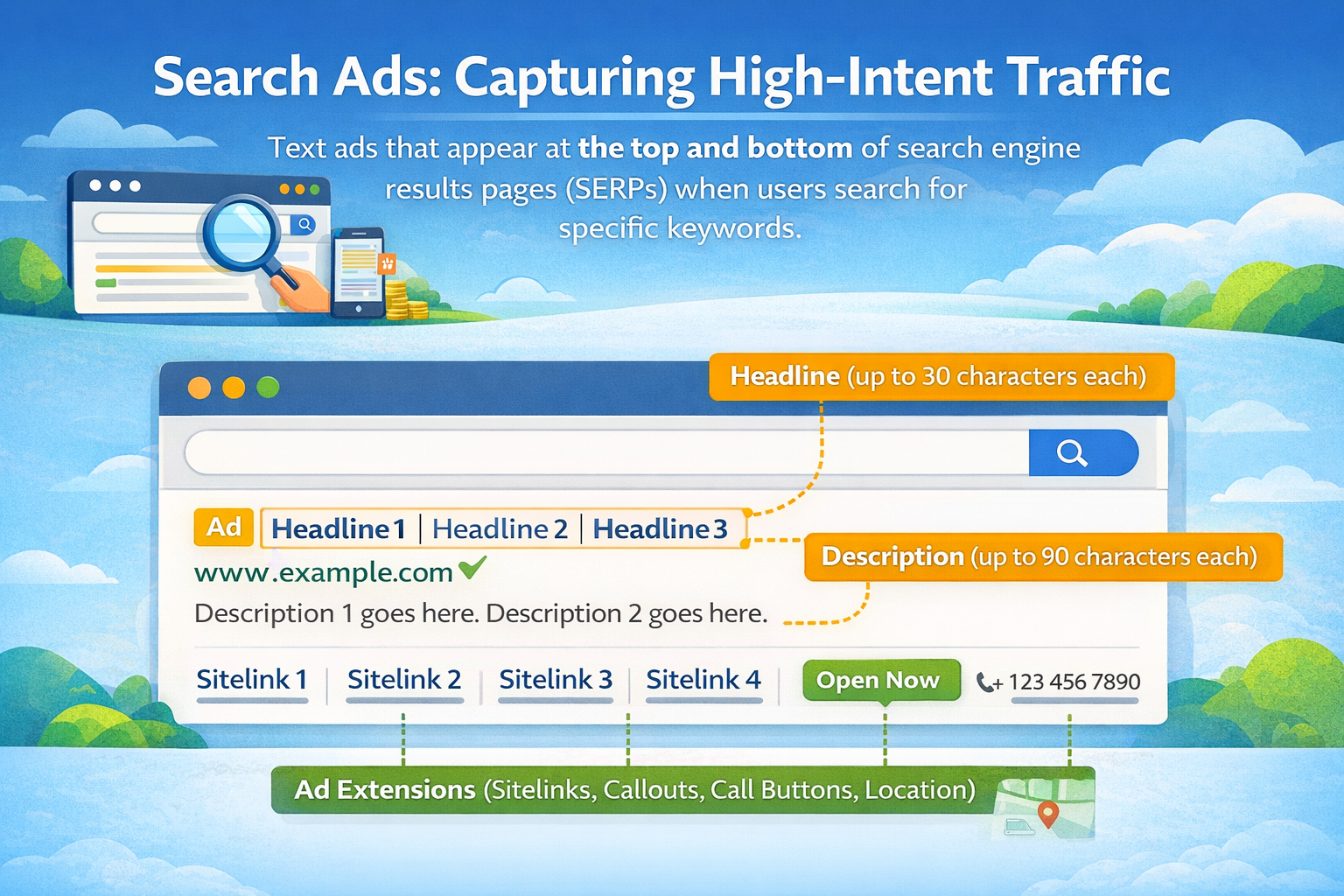
Search Ads in 2026
1. Search Ads: Capturing High-Intent Traffic
What They Are: Text-based advertisements appearing at the top and bottom of search engine results pages (SERPs) when users search for specific keywords.
Components:
- Headline (up to 30 characters, 3 headlines maximum)
- Description (up to 90 characters, 2 descriptions maximum)
- Display URL
- Ad extensions (sitelinks, callouts, call buttons, location)
Include keywords in headlines • Highlight unique selling propositions • Use strong calls-to-action • Leverage all available ad extensions • Match ad copy to landing page content
Average Performance: Search ads typically achieve CTRs of 3-5% with high conversion intent.
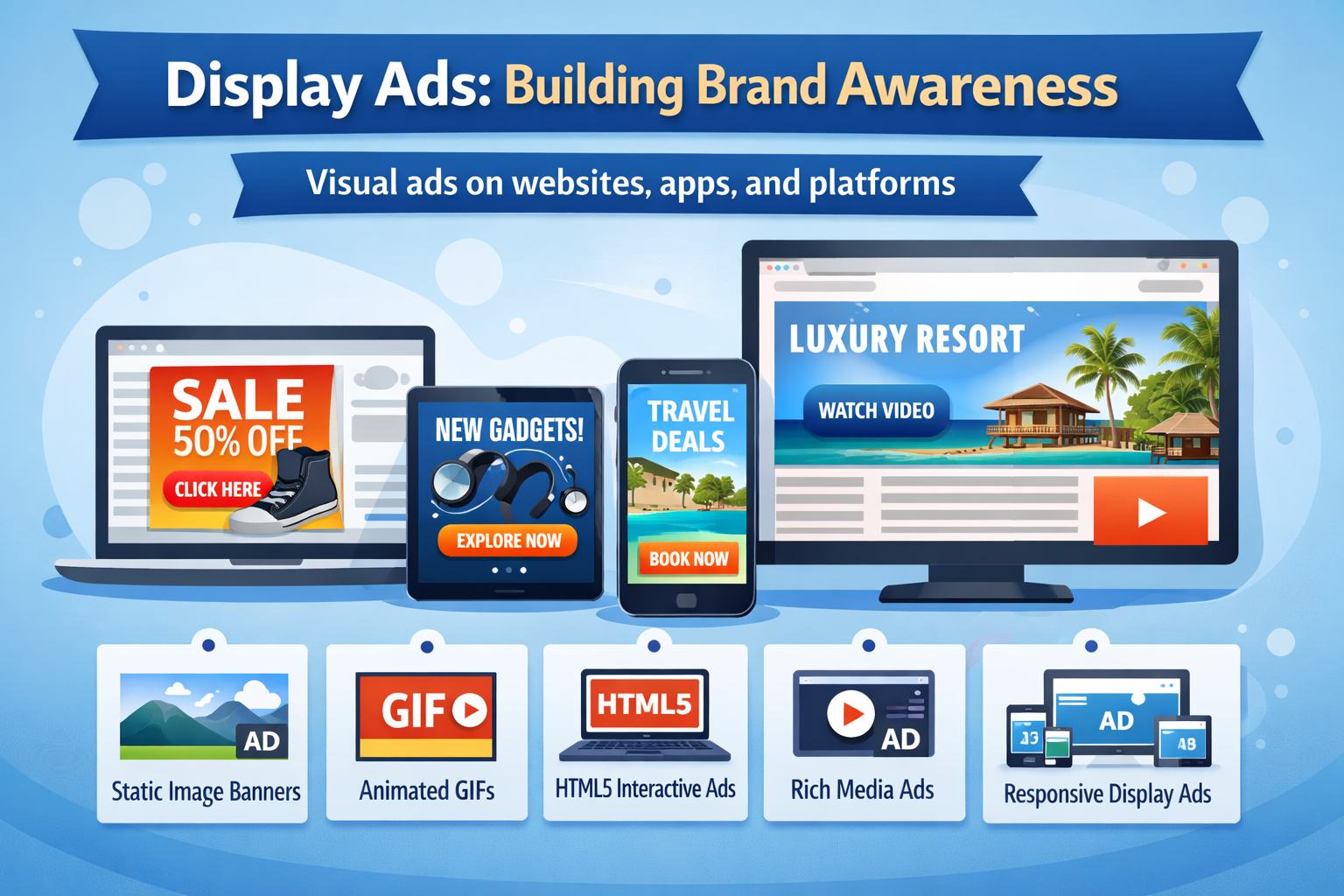
Display ads in 2026
2. Display Ads: Building Brand Awareness
What They Are: Visual banner advertisements appearing on websites, apps, and platforms within advertising networks.
Formats:
- Static image banners
- Animated GIFs
- HTML5 interactive ads
- Rich media ads
- Responsive display ads (auto-adjust size)
When to Use: Brand awareness campaigns, Product launches, Visual storytelling, Top-of-funnel marketing, Retargeting website visitors.
Pricing: Usually CPM (cost-per-thousand-impressions) ranging from $0.50-$4.00
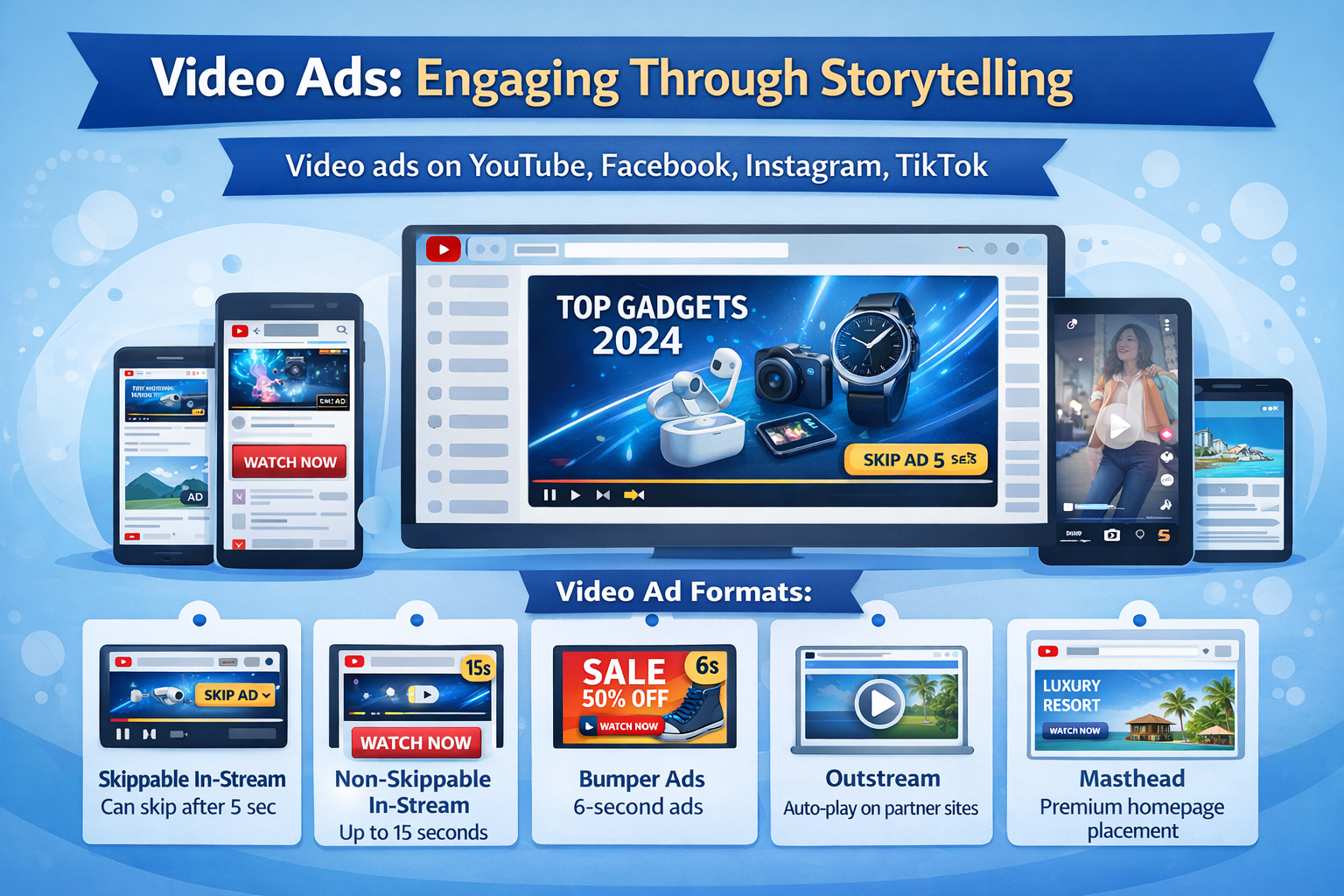
Video ad formats and storytelling tips 2026
3. Video Ads: Engaging Through Storytelling
What They Are: Video content used to promote products, services, or brands across platforms like YouTube, Facebook, Instagram, and TikTok.
Video Ad Formats:
- Skippable in-stream: Can skip after 5 seconds (ideal for longer content)
- Non-skippable in-stream: Must watch completely (15 seconds max)
- Bumper ads: 6-second non-skippable (brand reinforcement)
- Outstream: Auto-play on partner sites without sound
- Masthead: Premium placement on platform homepages
Hook viewers in first 3 seconds • Design for sound-off viewing (add captions) • Clear branding throughout • Strong call-to-action • Optimize for mobile viewing
Pricing Models: CPV (cost-per-view), typically $0.10-$0.30 per view
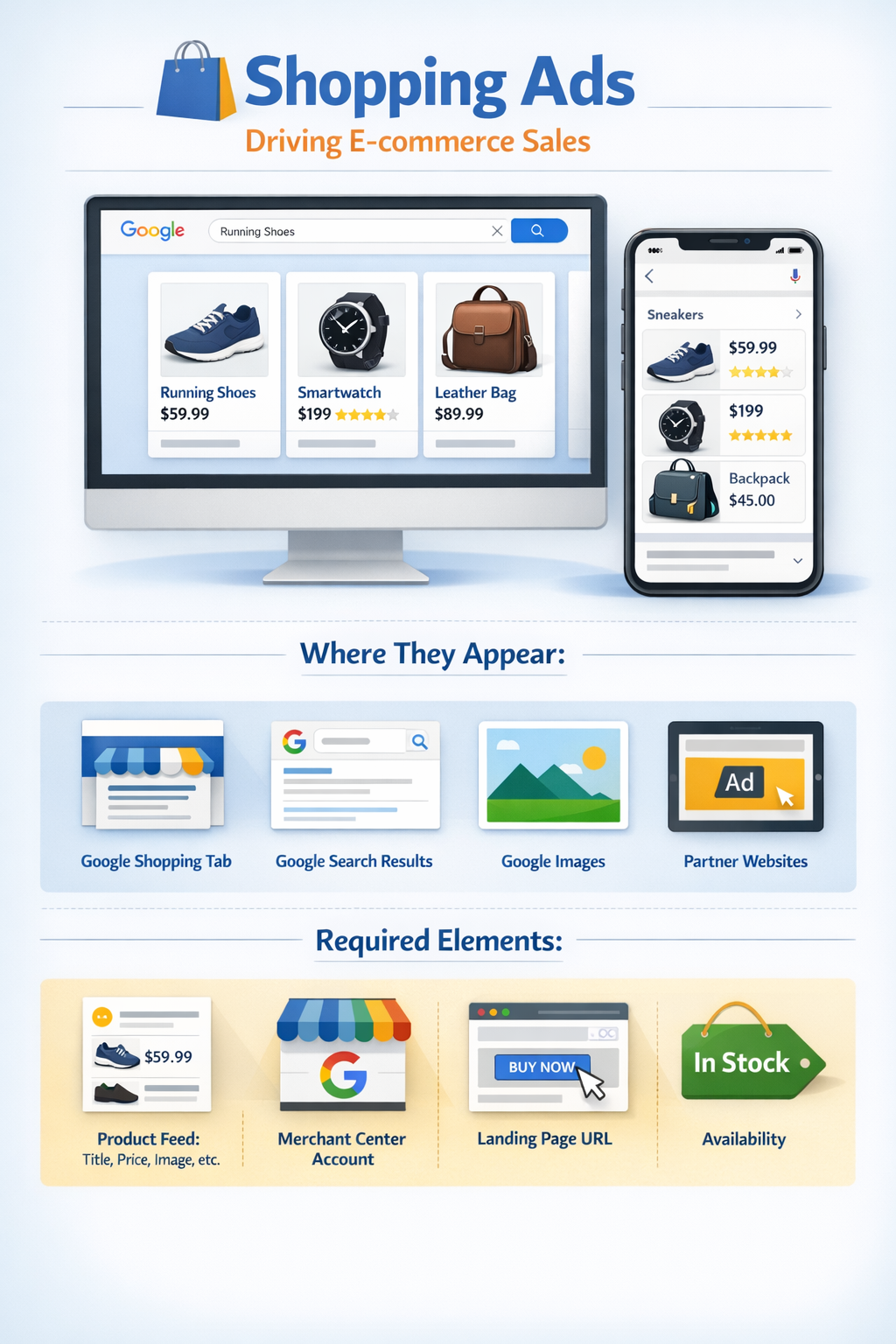
E-commerce shopping ads in 2026
4. Shopping Ads: Driving E-commerce Sales
What They Are: Product-based ads showing images, prices, merchant names, and ratings directly in search results.
Where They Appear:
- Google Shopping tab
- Google Search results
- Google Images
- Partner websites
Required Elements:
- Product feed (title, description, price, image, availability)
- Merchant Center account
- Landing page URL
Performance Advantage: Shopping ads often achieve 30% higher conversion rates than text ads for e-commerce.
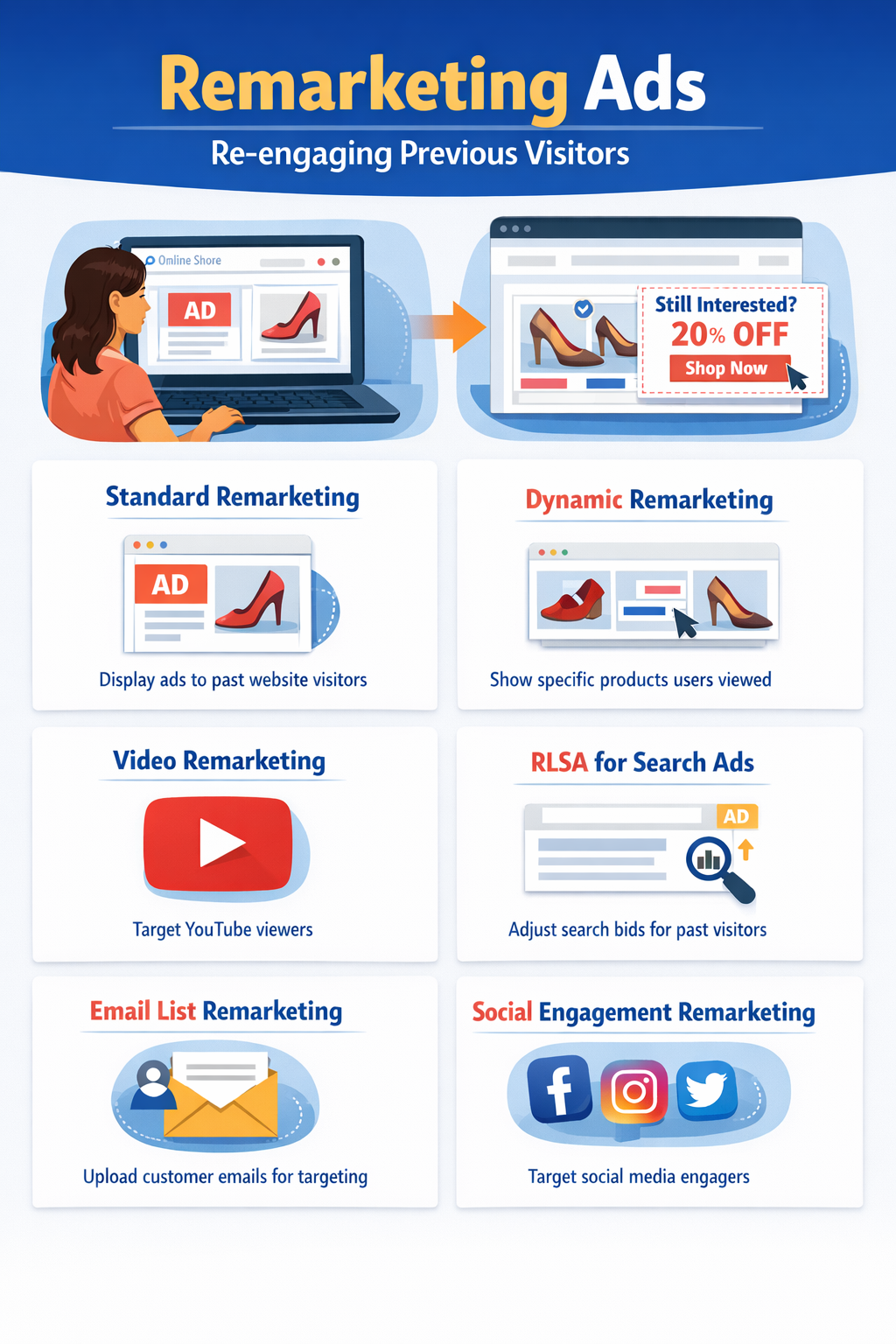
Remarketing ad strategies in 2026
5. Remarketing Ads: Re-engaging Previous Visitors
What They Are: Targeted ads shown to users who previously visited your website, app, or interacted with your content.
Remarketing Strategies:
- Standard remarketing: Display ads to past website visitors
- Dynamic remarketing: Show specific products users viewed
- Video remarketing: Target YouTube viewers
- RLSA (Remarketing Lists for Search Ads): Adjust search bids for past visitors
- Email list remarketing: Upload customer emails for targeting
- Engagement remarketing: Target social media engagers
When to Use: Cart abandonment recovery, Lead nurturing, Brand reinforcement, Upselling to existing customers, Long sales cycle products.
Remarketing typically achieves 2-3x higher conversion rates than standard display advertising.
PPC Campaign Strategy and Planning
Successful PPC campaigns require strategic planning before spending a single dollar. Follow this comprehensive framework:
1. Define Clear Campaign Objectives
Establish specific, measurable goals aligned with business objectives:
Awareness Goals:
- Increase brand impressions
- Grow social media following
- Generate video views
Consideration Goals:
- Drive website traffic
- Generate leads
- Increase email subscribers
- Promote content downloads
Conversion Goals:
- Generate sales
- Increase online transactions
- Drive phone calls
- Schedule appointments
Set numerical targets: “Generate 100 qualified leads per month” or “Achieve $50,000 in revenue with 4:1 ROAS.”
2. Conduct Comprehensive Keyword Research
Keywords are the foundation of search PPC campaigns. Research thoroughly:
Keyword Research Tools:
- Google Keyword Planner
- SEMrush
- Ahrefs
- Moz Keyword Explorer
- Answer the Public
Keyword Types:
| Match Type | How It Works | Example | Control Level |
|---|---|---|---|
| Broad Match | Triggers for variations, synonyms, related searches | running shoes → matches “athletic footwear” | Low (use with negatives) |
| Phrase Match | Triggers for searches containing your keyword phrase | “running shoes” → “best running shoes” | Medium (balanced) |
| Exact Match | Triggers only for searches with same intent | [running shoes] → “running shoes” | High (most control) |
Keyword Intent Categories:
- Navigational: User seeking specific website (brand names)
- Informational: Seeking knowledge (“how to,” “what is”)
- Commercial: Researching before purchase (“best,” “review,” “comparison”)
- Transactional: Ready to purchase (“buy,” “discount,” “near me”)
Priority: Focus on commercial and transactional keywords for conversion campaigns.
3. Set Budget and Bidding Strategy
Budget Calculation Method:
Determine Target CPA
Calculate your target cost per acquisition based on profit margins and customer lifetime value.
Estimate Conversion Rate
Use industry benchmarks or historical data to estimate your conversion rate (typically 2-5%).
Calculate Required Traffic
Divide your target leads by conversion rate to determine how many clicks you need.
Multiply by Average CPC
Research average CPC for your keywords and multiply by required clicks for your budget.
Target: 50 leads per month • Conversion rate: 5% • Required clicks: 1,000 • Average CPC: $2 • Monthly budget: $2,000
Bidding Strategies:
| Strategy | Control Level | Best For |
|---|---|---|
| Manual CPC | Full control | Testing phase, learning |
| Enhanced CPC | Manual with automation | Transition to automation |
| Maximize Clicks | Automated | Traffic-focused campaigns |
| Target CPA | Automated | Lead generation |
| Target ROAS | Automated | E-commerce sales |
| Maximize Conversions | Automated | Maximum results within budget |
4. Optimize Landing Pages
Your landing page determines conversion success:
Landing Page Essentials:
- Message match: Align with ad copy
- Clear headline: Reinforce the value proposition
- Strong visuals: Support messaging
- Benefit-focused copy: Explain “what’s in it for them”
- Trust signals: Testimonials, reviews, certifications
- Single focus: One clear goal per page
- Fast load speed: Under 3 seconds
- Mobile optimization: Responsive design
- Compelling CTA: Prominent, action-oriented button
How to Learn PPC Marketing
PPC marketing is a continuously evolving field. Here’s how to build and maintain expertise:
Official Platform Training
Google Skillshop:
- Free Google Ads certification
- Structured learning paths
- Updated regularly with platform changes
- Covers Search, Display, Video, Shopping, Apps
Microsoft Advertising Learning Lab:
- Free Bing Ads certification
- Similar content structure to Google
- Valuable for Bing-specific features
Meta Blueprint:
- Facebook and Instagram advertising certification
- Comprehensive courses on social advertising
- Creative strategy training
Hands-On Practice
Start Small: Launch campaigns with $5-10/day budgets • Test on your own business or side projects • Manage friends’ or family businesses’ campaigns • Offer pro-bono work for nonprofits
Experimentation Framework:
- Start with one platform (Google Ads recommended)
- Master one campaign type before diversifying
- Document learnings and results
- Scale what works, cut what doesn’t
Stay Updated
PPC platforms change constantly. Stay current:
- Subscribe to platform update newsletters
- Attend virtual conferences (SMX, HeroConf)
- Follow industry experts on social media
- Test new features in beta programs
- Read quarterly platform reports
Common PPC Mistakes to Avoid
Learn from others’ errors to accelerate your success:
Neglecting Negative Keywords
The Mistake: Failing to add negative keywords allows your ads to show for irrelevant searches, wasting budget on unqualified clicks.
The Solution: Build negative keyword lists from day one. Review search term reports weekly and add irrelevant terms as negatives.
Sending Traffic to Homepage
The Mistake: Directing all ad traffic to generic homepages instead of targeted landing pages reduces conversion rates significantly.
The Solution: Create dedicated landing pages matching ad messaging and user intent. Each campaign should have purpose-built landing pages.
Ignoring Mobile Optimization
The Mistake: Over 60% of searches happen on mobile, yet many advertisers don’t optimize for mobile users.
The Solution: Design mobile-first landing pages, adjust bids for mobile devices, use mobile-specific ad extensions like call buttons.
Setting and Forgetting Campaigns
The Mistake: Launching campaigns without ongoing optimization leads to wasted spend and declining performance.
The Solution: Schedule regular optimization sessions. Review performance weekly, test continuously, adjust based on data.
Not Testing Ad Variations
The Mistake: Running a single ad per ad group prevents you from learning what resonates with your audience.
The Solution: Always run 2-3 ad variations per ad group. Test headlines, descriptions, and calls-to-action systematically.
Overlooking Quality Score
The Mistake: Focusing solely on bids while ignoring Quality Score increases costs and reduces ad positions.
The Solution: Optimize for relevance—improve landing pages, enhance ad-to-keyword alignment, boost expected CTR through compelling copy.
The Future of PPC Marketing
PPC continues evolving rapidly. Understanding emerging trends helps you stay competitive:
AI and Machine Learning Integration
Automation increasingly handles bidding, targeting, and optimization. Google’s Performance Max and Smart Bidding represent this shift. Success requires:
- Providing quality signals (conversion data)
- Setting clear goals
- Maintaining creative excellence
- Human oversight and strategic direction
Privacy-First Advertising
Cookie deprecation and privacy regulations (GDPR, CCPA) are reshaping targeting:
- First-party data becomes critical
- Contextual targeting resurges
- Enhanced conversion tracking methods
- Privacy-compliant remarketing solutions
Video Advertising Growth
Video consumption continues rising across all platforms:
- Short-form video dominance (TikTok, Reels, YouTube Shorts)
- Interactive video features
- Shoppable video ads
- Live stream advertising
Frequently Asked Questions About PPC Marketing
What is PPC marketing and how does it work?
PPC (pay-per-click) marketing is a digital advertising model where advertisers pay a fee each time someone clicks their ad. Advertisers bid on keywords relevant to their business, and ads appear when users search for those terms. Payment occurs only when users click, making it a cost-effective way to drive targeted traffic.
How much does PPC advertising cost?
PPC costs vary significantly based on industry, competition, and platform. Average cost-per-click ranges from $1-$2 on Google Search, $0.50-$1 on display networks, and $0.50-$3 on social platforms. You control spending by setting daily budgets. Start with $500-$1,000 monthly to gather meaningful data, then scale based on performance.
What’s the difference between PPC and SEO?
PPC is paid advertising delivering immediate results but requiring ongoing budget, while SEO focuses on organic rankings through content optimization and takes 3-6 months to show results. PPC offers precise targeting and instant visibility; SEO provides sustainable long-term traffic. Most successful strategies combine both approaches.
Which PPC platform is best for beginners?
Google Ads is recommended for beginners due to its massive reach, extensive learning resources, and versatile ad formats. Start with search campaigns targeting high-intent keywords with clear commercial value. Once comfortable, expand to display and video advertising or test platforms like Facebook Ads.
How long does it take to see PPC results?
PPC can drive traffic within hours of launching campaigns. However, optimization requires time—expect 1-2 weeks to gather initial data, 30-60 days to identify trends, and 90 days to fully optimize performance. Immediate traffic doesn’t guarantee immediate conversions; testing and refinement are essential.
What is a good ROI for PPC campaigns?
Industry average PPC ROI is $2 return for every $1 spent (200% ROI). However, “good” ROI depends on your industry, profit margins, and business model. E-commerce might target 4:1 ROAS, while lead generation businesses might accept 2:1 if customer lifetime value is high. Set ROI goals based on your specific business economics.
Do I need a big budget for PPC?
No. You can start with as little as $5-10 daily. Small budgets require focused targeting—fewer keywords, specific geographic areas, precise audience segments. Start small, identify what works, then scale budget to profitable campaigns. Efficiency matters more than budget size.
What is Quality Score and why does it matter?
Quality Score is Google’s 1-10 rating of your ad relevance, landing page experience, and expected CTR. Higher Quality Scores reduce your cost-per-click and improve ad positions. A Quality Score of 8-10 can reduce CPCs by 50% or more compared to scores of 1-3. Improve Quality Score through better ad-to-keyword matching and optimized landing pages.
Should I hire a PPC agency or do it myself?
Start with self-management if you have time to learn and small budgets ($1,000-$2,000 monthly). Consider professional PPC marketing services when scaling ($5,000+ monthly budgets), managing multiple platforms, or lacking time for ongoing optimization. Agencies bring expertise, tools, and experience but add 10-20% management fees.
Can PPC work for small local businesses?
Absolutely. Local businesses often see excellent PPC results through location-specific targeting, local search ads, and “near me” keywords. Google Local Service Ads are particularly effective for service businesses like plumbers, lawyers, and cleaners. Start with small geographic areas and expand as you prove ROI.
Conclusion: Taking Your First Steps with PPC Marketing
PPC marketing offers unmatched opportunities for businesses seeking immediate visibility, precise targeting, and measurable results. Whether you’re launching a new product, generating leads, or building brand awareness, PPC provides the tools and flexibility to achieve your goals.
Success in PPC requires strategic planning, continuous testing, and data-driven optimization. Start with clear objectives, thorough research, and small budgets. Master one platform before expanding to others. Monitor performance religiously, learn from data, and refine your approach constantly.
Ready to launch your first PPC campaign? Start with Google Ads search campaigns targeting high-intent keywords relevant to your business. Set a modest daily budget, create compelling ad copy, optimize your landing pages, and implement conversion tracking.
The PPC landscape evolves rapidly—platforms introduce new features, algorithms change, and user behavior shifts. Commit to ongoing education, stay updated on industry trends, and adapt your strategies accordingly.
Ready to Launch High-Performing PPC Campaigns?
At Digital Aura, our Dubai-based PPC experts manage comprehensive campaigns across all major platforms—from Google Ads and Microsoft Advertising to Facebook, Instagram, LinkedIn, and TikTok.
We handle everything: keyword research, ad creation, bid management, landing page optimization, conversion tracking, and continuous performance improvement.