As AI systems increasingly mediate how users discover, compare, and trust brands online, marketers are being forced to confront a new question:
If search engines rank pages, but AI engines generate answers, how do you optimise for both?
That question sits at the heart of the llms.txt debate. Some consider it hype. Others see it as an early signal of how AI-SEO (and GEO) will evolve. The truth, as usual in technical SEO, sits somewhere in between.
This guide explains what llms.txt actually is, why opinions are split, and when it genuinely matters, without overselling its impact or dismissing its relevance.
Key takeaways (TL;DR)
- llms.txt is not a ranking factor, but it is a content-signalling mechanism aimed at AI systems rather than search engines.
- The discussion around llms.txt is really about GEO vs SEO: ranking pages versus shaping AI-generated answers.
- The benefit of llms.txt is defensive and reputational, not traffic-driven.
- For authority-led brands, llms.txt is a low-risk, future-facing optimisation, not a silver bullet.
What is llms.txt?
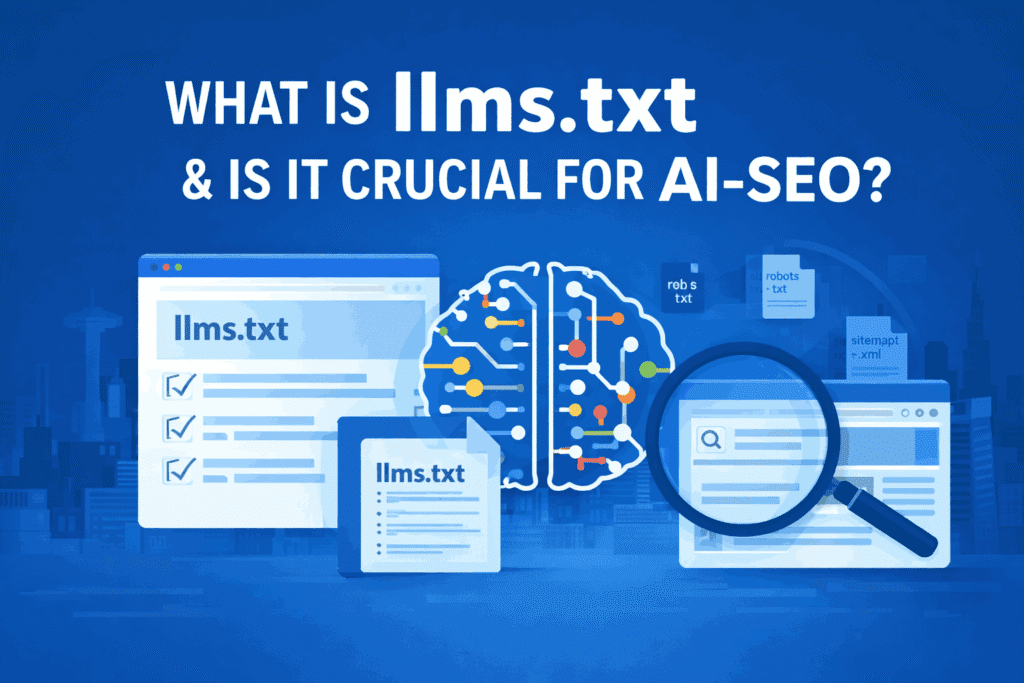
llms.txt is a plain-text or Markdown file placed in the root directory of a website (for example, digitalauramarketing.ae/llms.txt). Its purpose is to provide large language models with a clean, human-curated overview of the site’s most important content.
Instead of forcing an AI system to parse:
- complex navigation
- JavaScript-rendered content
- repetitive headers and footers
…llms.txt presents a simplified map of intent and authority.
At its core, it answers three questions for AI systems:
- What is this website about?
- Which pages define its expertise?
- Which content should be prioritised when summarising or citing it?
What llms.txt is not
Clarity matters here, because misinterpretation has fuelled much of the backlash.
llms.txt is not:
- a replacement for sitemap.xml
- a crawl-control mechanism like robots.txt
- an officially adopted Google or OpenAI standard
- a guarantee of AI citations or visibility
It does not:
- improve rankings
- influence indexation
- override poor content quality
If someone is selling llms.txt as an SEO breakthrough, that’s a red flag.
Why llms.txt exists at all
To understand llms.txt, you need to understand how AI discovery differs from search discovery.
Search engines:
- crawl URLs
- index pages
- rank results
- send traffic
AI systems:
- ingest content into context windows
- synthesise multiple sources
- compress nuance into probabilistic answers
- often remove attribution
In other words, AI doesn’t “recommend pages” it rewrites knowledge.
That creates a new risk for brands:
- services being misrepresented
- outdated content resurfacing
- competitors being blended into generic answers
llms.txt exists to reduce ambiguity, not to manipulate outcomes.
GEO vs SEO: the real conversation
Most confusion around llms.txt disappears once you separate SEO from GEO.
Traditional SEO
SEO focuses on:
- crawlability
- indexation
- rankings
- click-through rate
Its success is measured in:
- impressions
- traffic
- conversions
Generative Engine Optimisation (GEO)
GEO focuses on:
- how content is interpreted by AI
- how brands are described in generated answers
- whether information is accurate, current, and attributed
Its success is measured in:
- visibility within AI answers
- citation consistency
- brand framing
llms.txt belongs firmly in the GEO layer, not the SEO layer.
The benefit of llms.txt
This is where the discussion needs maturity. The benefit of llms.txt is subtle but real.
1. Reduced AI hallucination risk
When AI systems lack clarity, they infer. Inference leads to:
- incorrect service lists
- assumed pricing models
- blended competitor positioning
A curated llms.txt reduces guesswork.
2. Cleaner AI ingestion for complex sites
For sites that rely heavily on:
- JavaScript
- headless CMS frameworks
- dynamic content loading
llms.txt provides a static, parseable fallback.
3. Brand authority reinforcement
AI systems favour:
- consistency
- topical clarity
- authoritative anchors
llms.txt helps reinforce which pages carry weight.
4. Zero technical downside
It doesn’t:
- slow pages
- interfere with crawling
- conflict with SEO best practices
This is why many senior SEOs describe it as “harmless insurance.”
llms.txt vs robots.txt vs sitemap.xml
| File | Who it’s for | What it controls | Strategic role |
|---|---|---|---|
| robots.txt | Crawlers | Access permissions | Crawl efficiency |
| sitemap.xml | Search engines | URL discovery | Indexation |
| llms.txt | AI systems | Content prioritisation | AI interpretation |
They solve different problems at different layers of the web.
Why many experts say llms.txt “doesn’t matter”
Scepticism around llms.txt is not ignorance it’s rational.
Common objections include:
- no formal documentation from major LLM providers
- inconsistent crawling behaviour
- lack of measurable ROI
- stronger alternatives like schema and entity optimisation
These critiques are valid today.
However, they assume success should be measured in short-term SEO metrics, which GEO does not currently provide.
Why some major platforms still use it
Despite scepticism, organisations like Cloudflare and Anthropic maintain llms.txt files.
Why?
Not for rankings — but for:
- documentation clarity
- developer accuracy
- controlled interpretation
That alone should reframe the discussion.
How to create an effective llms.txt
Start with intent, not automation
The strongest llms.txt files are written by humans who understand:
- the business model
- the audience
- the core value proposition
Automation should follow strategy, not replace it.
Structure matters
An effective file typically includes:
- an H1 defining the site
- a concise site summary
- grouped links by intent (services, resources, documentation)
Prioritise cornerstone content
For marketing agencies, this usually means:
- core service pages
- in-depth strategy guides
- evergreen educational resources
For example, if SEO and growth strategy are central, linking to your SEO services and digital marketing pages creates a clear authority signal:
Keep it updated, not perfect
Stale llms.txt files are worse than missing ones.
Quarterly reviews are usually sufficient.
E-E-A-T in an AI-first environment
Google’s Helpful Content framework prioritises Experience, Expertise, Authority, and Trust.
AI systems implicitly do the same.
llms.txt supports E-E-A-T by:
- reinforcing topical boundaries
- reducing ambiguity
- pointing models toward authoritative pages
But it cannot compensate for:
- weak content
- thin service pages
- lack of real expertise
It amplifies quality — it does not create it.
Measuring impact: what’s realistic
There is currently no reliable analytics layer for GEO.
What you can monitor:
- how AI tools describe your services
- whether AI answers cite your brand accurately
- consistency across platforms
What you should not expect:
- immediate traffic growth
- ranking changes
- clear attribution data
llms.txt is reputational optimisation, not performance marketing.
Is llms.txt crucial for AI-SEO?
For most businesses:
- Not crucial
- Not urgent
- Not transformative
But for brands that rely on:
- authority
- trust
- professional services
- AI-driven discovery
…it is increasingly strategic.
Ignoring how AI systems interpret your content is the modern equivalent of ignoring SEO in 2005 — not fatal today, but limiting tomorrow.
FAQs
What is llms.txt in simple terms?
A small text file that helps AI systems understand what your website is about and which pages define your expertise.
Does llms.txt help with Google rankings?
No. It does not influence rankings or indexation.
Is llms.txt better than sitemap.xml?
No. They serve different purposes and should coexist.
Do AI tools actually read llms.txt?
Some do experimentally. Support is inconsistent and undocumented.
Should agencies implement llms.txt for clients?
Only when it aligns with authority, content quality, and long-term strategy.
Final perspective
llms.txt isn’t important because everyone is using it.
It’s important because AI has changed how knowledge is consumed, and most optimisation frameworks haven’t caught up yet.
Used correctly, llms.txt is not a shortcut — it’s a signal of intent, clarity, and preparedness in an AI-mediated web.
Ready to Elevate Your AI SEO Strategy?
If you’re serious about gaining AI-first visibility, dominating voice- and assistant-driven queries, and future-proofing your site—with optimized llms.txt and AI-aware SEO best practices—let’s talk.
Digital Aura helps you:
- Design and validate llms.txt / llms-full.txt files aligned with brand content
- Integrate GEO standards into your CMS, headless stack, WordPress or static site
- Continuously monitor AI crawler behavior, update permissions, and track visibility impact
- Position your website as a trusted AI-ready resource for both humans and LLMs
Let us build your competitive edge in AI search, reach out today for a free consultation and sample llms.txt tailored to your content strategy!