What Are ChatGPT Ads?
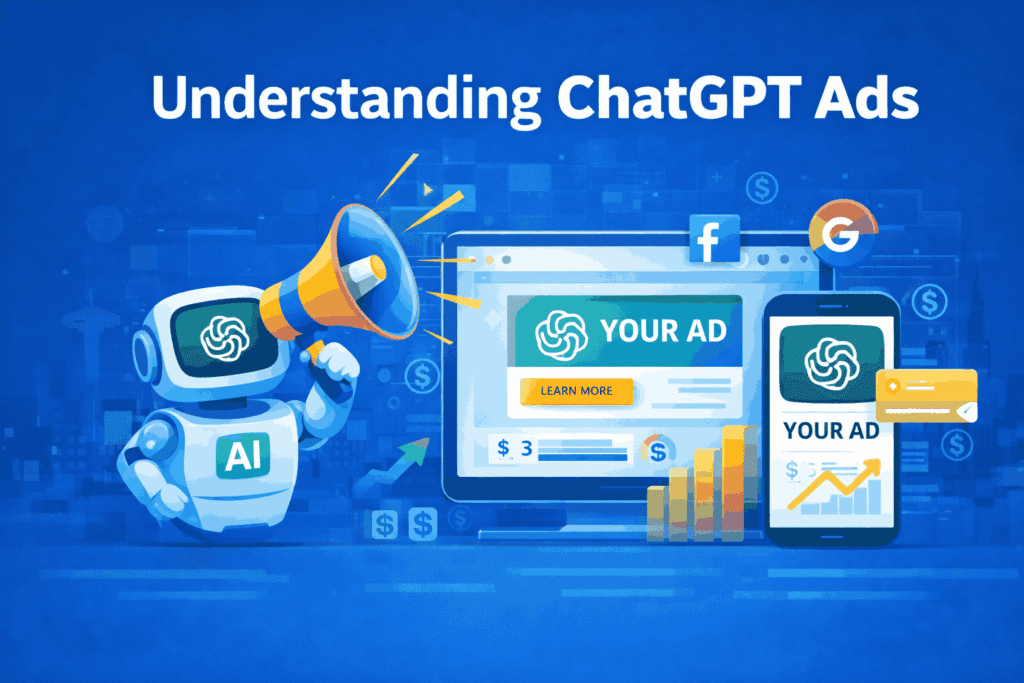
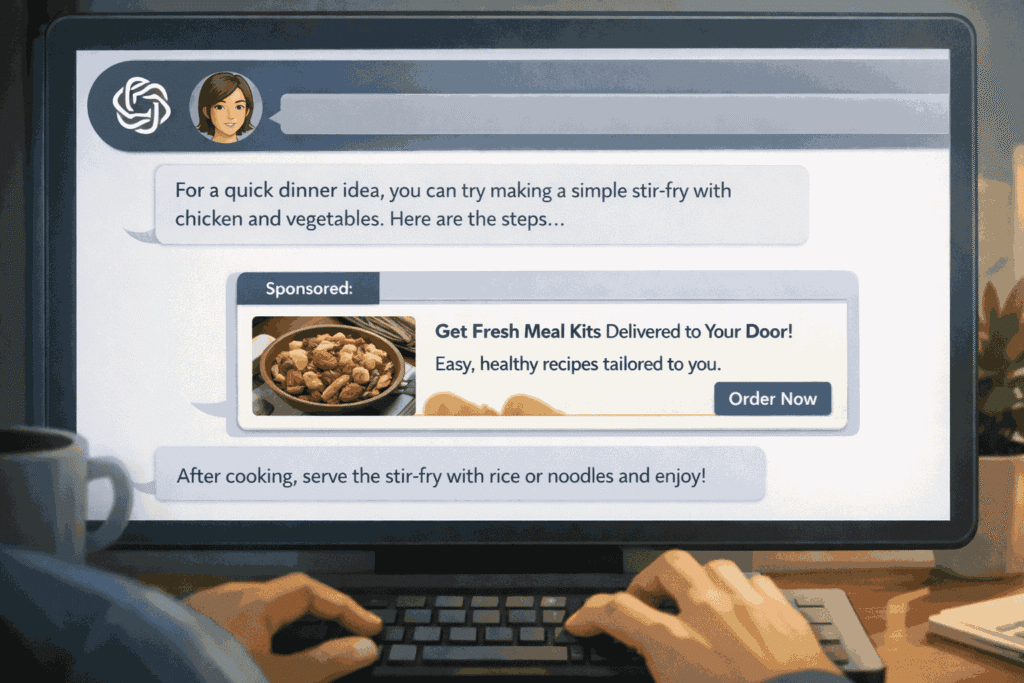
ChatGPT ads are sponsored messages that appear within AI-generated responses to user queries. Launched in January 2026, these advertisements represent OpenAI’s first major monetization effort for ChatGPT’s Free and Plus (Go) tiers in the United States.
Unlike traditional search ads that appear separate from organic results, ChatGPT ads are integrated directly into conversational AI responses, creating a fundamentally new advertising format that blends promotional content with helpful information.
Key characteristics of ChatGPT ads:
- Appear within the conversational flow of AI responses
- Clearly labeled as sponsored content
- Target users based on query intent and context
- Available only to Free and Go tier users initially
- Separate from the core answer according to OpenAI
Why ChatGPT Advertising Matters for Marketers in 2026
The introduction of advertising into ChatGPT marks a critical inflection point in digital marketing. With over 200 million weekly active users as of late 2024, ChatGPT has become one of the internet’s highest-intent environments where users actively seek answers, make decisions, and plan purchases.
This shift matters because AI assistants are transitioning from productivity tools to full-fledged media platforms. The monetization model confirms what industry analysts have predicted: conversational AI will become a primary distribution channel for brands, competing directly with traditional search engines, social media, and display advertising networks.
The Scale of the Opportunity
ChatGPT’s user base has grown exponentially since its November 2022 launch. The platform processes billions of queries monthly, with users demonstrating clear commercial intent across categories including travel planning, product research, business solutions, educational services, and purchasing decisions.
This concentrated intent, combined with AI’s ability to understand context and provide personalized recommendations, creates advertising opportunities that surpass traditional search in targeting precision and user engagement.
How ChatGPT Ads Differ From Traditional Search Advertising
Traditional Search Ads: The Separation Model
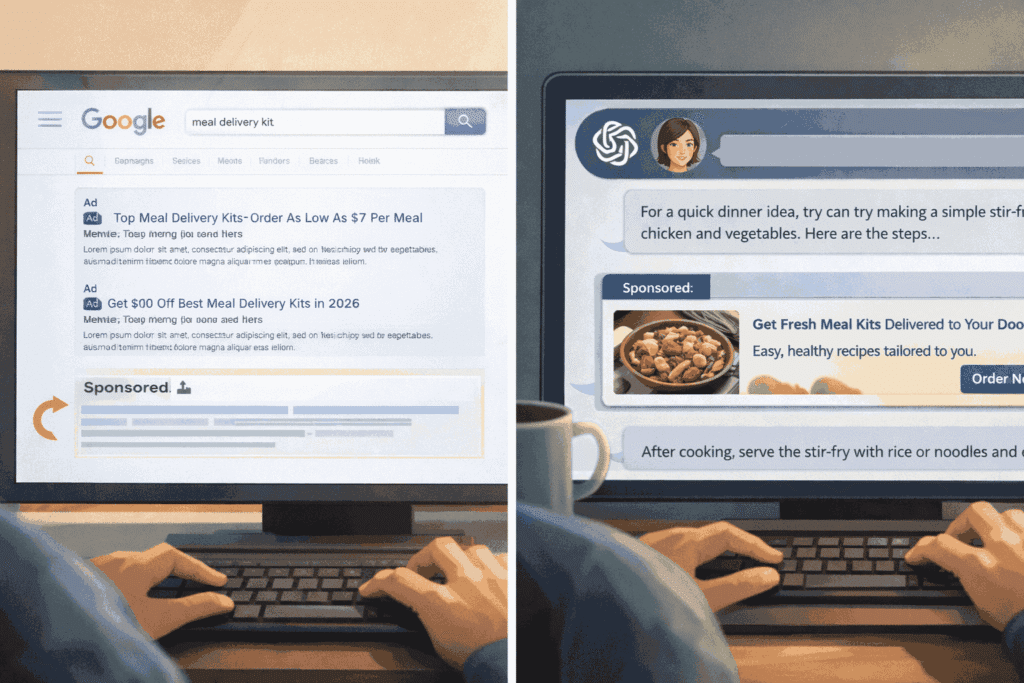
Google search ads have operated on a clear separation principle for over two decades. Advertisements appear in designated spaces above, below, or alongside organic search results. Users can easily distinguish paid placements from editorial content, scroll past sponsored listings, and compare multiple options before clicking.
The search results page provides visual hierarchy through labels, spacing, and formatting that maintains clear boundaries between commercial and organic content.
ChatGPT Ads: The Integration Model
ChatGPT ads function fundamentally differently. They exist within a conversational thread rather than on a static results page. Even when labeled as sponsored, these ads appear as part of the same dialogue where users receive assistance, advice, and information.
This integration creates several unique dynamics:
Contextual embedding: Ads appear at moments of peak receptivity when users are actively engaged with the AI assistant and trusting its guidance.
Conversational flow: Rather than interrupting the experience, ads are woven into the natural progression of the interaction, making them feel less intrusive than traditional advertising.
Proximity to trusted guidance: When helpful information and sponsored content share the same interface, the credibility of the platform transfers to the advertiser through association.
Reduced comparison friction: Unlike search results pages where users can easily compare multiple options, conversational AI presents information sequentially, potentially reducing competitive evaluation.
The Recommendation Effect
This positioning transforms ads from promotional interruptions into quasi-recommendations. While OpenAI maintains that ads do not influence ChatGPT’s core answers, the psychological impact of placement creates an implied endorsement that traditional search advertising cannot replicate.
The Trust Transfer Phenomenon in AI Advertising
Trust represents the most valuable and scarce resource in AI-driven advertising. When users interact with ChatGPT, they develop a relationship with the AI assistant based on helpfulness, accuracy, and perceived objectivity.
How Platform Trust Affects Advertiser Credibility
Research in cognitive psychology demonstrates that trust is transferable through association. When a trusted entity (the AI assistant) presents information alongside a brand (the advertiser), users subconsciously extend some of that trust to the brand itself.
This creates advertising influence beyond anything achieved through display ads, search listings, or social media promotions. The brand gains credibility not just through visibility but through contextual proximity to intelligence and helpfulness.
OpenAI’s Separation Strategy
OpenAI has explicitly stated that advertisements will not influence the factual answers ChatGPT provides. This ethical boundary is critical for maintaining platform integrity and user trust. However, from a user perception standpoint, the distinction may blur over time.
When helpful answers and relevant ads appear in the same conversational thread, users may not cognitively separate them as distinctly as they do with traditional search results. The conversational format itself encourages a unified interpretation of the content stream.
Long-Term Trust Implications
The sustainability of this advertising model depends entirely on maintaining user trust. If ChatGPT users begin to perceive the platform as prioritizing advertiser interests over helpfulness, the entire value proposition collapses.
This creates both opportunity and risk for advertisers. Brands that align genuinely with user needs and provide legitimate value will benefit from the trust transfer. Those that abuse the proximity to intelligence with misleading or low-quality offers risk not only campaign failure but potential platform removal.
Impact on Organic Visibility and the Zero-Click Future
The Shrinking Real Estate Problem
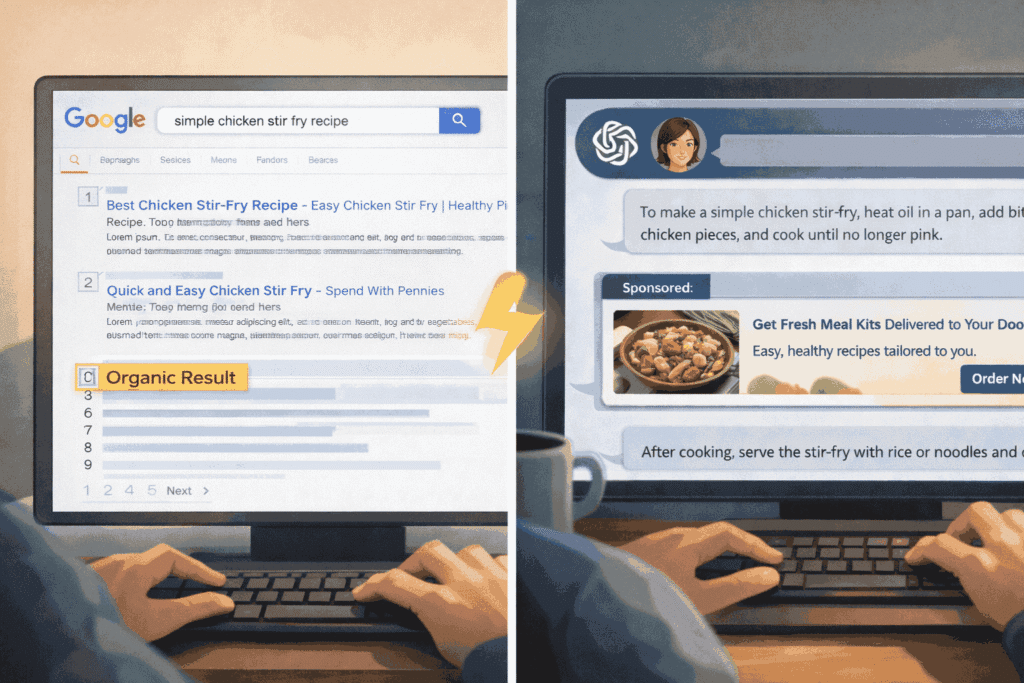
Traditional search results pages, while increasingly crowded with ads and features, still offer multiple visibility opportunities. Position one through ten on Google each represents a chance for organic discovery. ChatGPT’s conversational interface provides no such backup options.
When AI provides a direct answer or recommendation, there is no second page, no scrolling through alternatives, and no “ten blue links” safety net. The interface accommodates far fewer organic mentions, and now a portion of that limited space is allocated to paid placements.
Accelerating Zero-Click Behavior
Google has faced criticism for years over zero-click searches where users get answers directly from search features without visiting websites. ChatGPT takes this dynamic to its logical extreme.
Users receive comprehensive answers, step-by-step guidance, and actionable recommendations entirely within the chat interface. Websites become reference sources for the AI rather than destinations for users. The introduction of ads intensifies this trend by providing commercial solutions directly within the answer environment.
What This Means for Website Traffic
Brands can no longer rely on traditional click-through metrics as primary success indicators. Visibility in AI environments operates differently:
Citation over traffic: Being mentioned by the AI as a source or recommendation becomes more valuable than receiving direct clicks.
Authority over access: The goal shifts from getting users to visit your site to ensuring the AI recognizes your brand as authoritative in your category.
Model training over traditional SEO: Long-term visibility depends on producing content that trains AI models to recognize your expertise and recommend your solutions.
SEO Evolution: From Rankings to AI Selection
Traditional SEO Metrics Become Insufficient
Keyword rankings, domain authority, and backlink profiles remain important for traditional search visibility, but they represent only part of the equation in AI-driven discovery.
The new visibility game requires Search Engine optimization for how AI models understand, interpret, and recommend content. This involves:
Structured information architecture: Organizing content in ways that AI can easily parse, understand, and cite accurately.
Entity-based optimization: Ensuring your brand, products, and expertise are clearly defined as distinct entities that AI models can reference confidently.
Authoritative depth: Creating comprehensive, expert-level content that establishes your brand as the definitive source on specific topics.
Multi-format content: Providing information across text, data, images, and other formats that feed different aspects of AI understanding.
Answer Engine Optimization (AEO) Fundamentals
Answer Engine Optimization focuses specifically on making content selectable by AI assistants. Key principles include:
Direct answer formatting: Structuring content to provide clear, quotable answers to specific questions without requiring users to hunt through paragraphs.
Contextual comprehensiveness: Covering topics thoroughly enough that AI models can extract accurate information regardless of how users phrase their queries.
Fact-based clarity: Presenting information in factual, unambiguous language that AI can confidently cite without risk of misinterpretation.
Schema and structured data: Implementing technical markup that helps AI understand the semantic meaning and relationships within your content.
Generative Engine Optimization (GEO) Strategies
GEO extends beyond traditional SEO to influence how generative AI models represent your brand:
Consistent entity definition: Ensuring your brand identity, value propositions, and key differentiators appear consistently across all content sources that might train AI models.
Relationship mapping: Clearly articulating how your products, services, and expertise relate to user needs, competitive alternatives, and industry categories.
Authoritative positioning: Building recognition as a category leader or subject matter expert through depth of coverage and quality of insights.
Multi-source validation: Appearing across diverse, credible sources so AI models recognize your authority through corroboration rather than single-source claims.
Search Everywhere: The Unified Discovery Landscape
Beyond Traditional Search Channels
ChatGPT ads do not compete solely with Google search ads. They represent a new category of discovery advertising that intersects with every digital channel where users seek information and make decisions.
Users now discover brands and products through:
- Traditional search engines (Google, Bing)
- AI assistants (ChatGPT, Claude, Perplexity)
- Social media feeds (TikTok, Instagram, YouTube)
- Voice assistants (Alexa, Siri, Google Assistant)
- Platform-specific search (Amazon, LinkedIn, Reddit)
- App store optimization (iOS, Android)
Each channel feeds different aspects of AI understanding and user discovery. Visibility in one channel influences credibility in others as AI systems cross-reference sources.
The Search Everywhere Optimization Framework
Effective visibility in AI-driven discovery requires a unified approach:
Cross-channel authority building: Establishing expertise across all platforms where your audience seeks information, not just traditional web search.
Consistent signal reinforcement: Ensuring your brand messaging, value propositions, and differentiators appear consistently across channels so AI models recognize clear patterns.
Platform-specific optimization: Adapting content format and style to each platform’s unique dynamics while maintaining core message consistency.
Performance data integration: Using behavioral signals from all channels to understand how users actually discover and evaluate solutions in your category.
Why Fragmented Optimization Fails
Brands that optimize each channel in isolation miss the systemic nature of modern discovery. AI models synthesize information from multiple sources. If your LinkedIn presence emphasizes different strengths than your website content, you dilute rather than reinforce your authority.
Search Everywhere Optimization treats all discovery channels as interconnected components of a unified visibility strategy where each element strengthens the others.
Preparing for AI Advertising: Strategic Imperatives
For Advertisers: Understanding the New Landscape
Brands planning to advertise within ChatGPT and similar AI platforms should prepare differently than for traditional search campaigns:
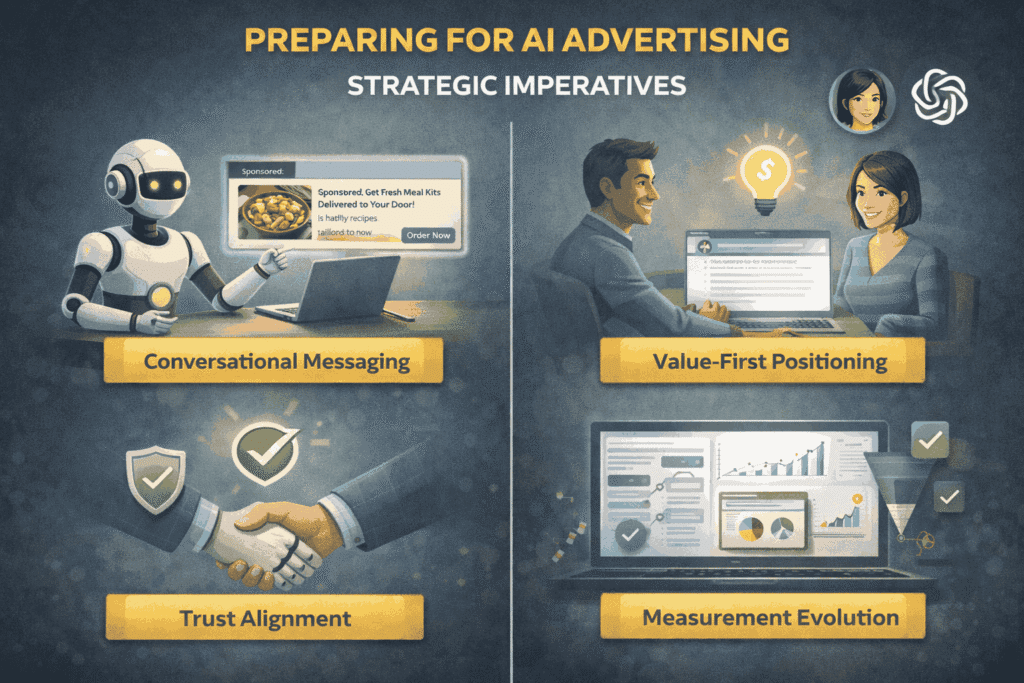
Conversational messaging: Ads must feel native to dialogue rather than promotional interruptions. The tone, format, and value proposition need to align with how users interact with AI assistants.
Value-first positioning: In an environment where the AI is helping users, ads must demonstrate clear, immediate value rather than relying on attention-grabbing tactics.
Trust alignment: Advertisers should rigorously ensure their offerings match user intent and genuinely solve problems to avoid degrading the trust transfer effect.
Measurement evolution: Success metrics will likely differ from traditional advertising, potentially emphasizing brand lift, assisted conversions, and influence on AI-mediated decisions rather than direct click-through rates.
For Brands Pursuing Organic Visibility
Organic presence in AI-generated responses requires a different content and authority-building approach:
Become the definitive source: AI models favor authoritative, comprehensive sources. Surface-level content will not earn citations or recommendations.
Structured expertise: Organize information architecturally so AI can extract and reference specific facts, insights, and recommendations with confidence.
Multi-source validation: Build presence across credible platforms, publications, and communities to give AI models corroborating evidence of your authority.
Continuous freshness: AI systems increasingly value current, updated information. Regularly refresh content to maintain relevance in model understanding.
Balancing Paid and Organic Strategies
The most effective approach combines paid visibility for immediate presence with long-term organic authority building. Paid placements provide controlled messaging and immediate access to AI-mediated audiences. Organic authority ensures sustained visibility and citation in unpaid responses.
These strategies complement rather than compete when executed coherently.
The Marketplace Evolution: From Tool to Platform
AI as Infrastructure, Not Just Interface
The introduction of advertising fundamentally redefines what ChatGPT is. It transitions from a neutral tool that helps users accomplish tasks to a platform with commercial interests, revenue models, and stakeholder obligations.
This evolution follows a familiar pattern seen across digital platforms:
- Launch as free tool solving user problems
- Build massive user base and engagement
- Introduce monetization through advertising or subscriptions
- Balance user experience with revenue generation
- Evolve into full ecosystem with multiple stakeholder interests
ChatGPT is now entering phase four of this lifecycle.
Attention as Inventory
Once ads enter the equation, user attention becomes quantifiable inventory to be allocated, optimized, and sold. Every interaction represents potential advertising exposure. Conversations become conversion funnels. Questions become qualification opportunities.
This mirrors how social media platforms evolved from connection tools to advertising networks, but with one critical difference: the level of intent and decision-making proximity is far higher in AI assistance than in social browsing.
The Coming AI Advertising Ecosystem
ChatGPT ads represent only the beginning. As AI assistants proliferate across platforms, applications, and use cases, advertising opportunities will expand:
Vertical-specific AI: Industry-focused AI assistants for healthcare, finance, legal, and other sectors will develop specialized advertising models.
Embedded AI: Advertising within AI features embedded in productivity tools, creative applications, and business software.
Voice and visual AI: Advertising models for voice assistants and visual AI platforms will create new formats beyond text.
AI commerce: Direct purchasing through AI assistants will blur the line between advertising, recommendation, and transaction completely.
The brands that develop expertise in AI advertising now will hold significant advantages as this ecosystem matures.
Implementation Roadmap: What to Do Now
Immediate Actions (Next 30 Days)
Audit current visibility: Assess how your brand appears when users ask AI assistants about your category, solutions, and competitors.
Document AI responses: Systematically test how ChatGPT, Perplexity, Claude, and other AI tools currently discuss your brand and category.
Identify visibility gaps: Note where competitors appear but you don’t, where information about your brand is outdated or incomplete, and where AI misunderstands your value proposition.
Begin content optimization: Start restructuring high-priority content for better AI comprehension using AEO and GEO principles.
Medium-Term Strategy (90 Days)
Develop comprehensive AI visibility strategy: Create formal plans for both organic AI presence and potential paid advertising across emerging AI platforms.
Expand authoritative content: Publish in-depth resources that establish clear category expertise and provide AI models with citable information.
Build cross-platform presence: Ensure consistent brand representation across all platforms that feed AI model understanding.
Establish measurement frameworks: Develop methods to track AI mentions, citations, recommendations, and their impact on business outcomes.
Long-Term Positioning (6-12 Months)
Create AI-first content formats: Develop content specifically designed for AI consumption and recommendation rather than just human reading.
Build entity authority: Establish your brand as a recognized entity in AI model understanding through comprehensive, consistent, validated presence.
Test paid AI placements: When available, experiment with ChatGPT ads and similar offerings to understand effectiveness and optimization strategies.
Integrate AI visibility across marketing: Ensure all marketing activities consider and contribute to AI discoverability and authority.
Frequently Asked Questions About ChatGPT Ads
When will ChatGPT ads be available to all advertisers?
OpenAI has not announced a specific timeline for broad advertiser access. The initial rollout in January 2026 is a limited test with select advertising partners for US users on Free and Go tiers. Full availability will likely depend on testing results and platform development throughout 2026.
How much do ChatGPT ads cost?
Pricing information has not been publicly disclosed. Given the premium nature of the audience and high intent environment, expect pricing comparable to or exceeding top-tier search advertising rates. The cost model will likely involve some combination of impression-based and performance-based pricing.
Will ads appear for ChatGPT Plus or Team users?
Current announcements indicate ads will only appear for Free and Go tier users. Plus, Team, and Enterprise users are expected to maintain ad-free experiences as part of their subscription value, similar to how premium tiers work across other platforms.
How can I measure the effectiveness of AI advertising?
Measurement frameworks are still emerging. Expected metrics include brand lift studies, assisted conversion tracking, incremental traffic analysis, and surveys assessing brand awareness and purchase intent. Traditional click-through and direct conversion metrics may be less relevant in conversational AI contexts.
Can ChatGPT ads target specific audiences?
While detailed targeting capabilities have not been disclosed, expect contextual targeting based on user queries and conversational context. Demographic and behavioral targeting may also be available similar to traditional digital advertising platforms, subject to privacy considerations.
How do I optimize content for organic ChatGPT visibility?
Focus on comprehensive, authoritative content that directly answers user questions. Use clear structure, factual language, and proper schema markup. Build multi-source validation through presence across credible platforms. Establish clear entity definitions for your brand and expertise areas.
Will other AI platforms introduce advertising?
Almost certainly. Microsoft’s Copilot, Google’s Gemini, Perplexity, and other AI assistants face similar infrastructure costs and monetization pressures. Expect advertising models to emerge across the AI assistant landscape throughout 2026 and beyond.
Conclusion: The New Era of AI-Mediated Commerce
The introduction of advertising into ChatGPT marks more than a business model evolution for OpenAI. It signals the transformation of AI assistants from helpful tools into critical commercial infrastructure that will mediate billions of dollars in purchasing decisions.
For marketers, this creates both urgency and opportunity. Brands that develop expertise in AI visibility now, through both organic authority-building and strategic paid placement, will establish advantages that compound as AI adoption accelerates.
The winners in this new landscape will be those who understand that AI discovery is not another channel to add to the marketing mix but a fundamental shift in how people find, evaluate, and choose solutions. Success requires rethinking content strategy, measurement frameworks, and the basic definition of visibility itself.
The question is no longer whether AI will become central to digital marketing. The question is whether your brand will be visible when users ask AI for solutions in your category.
Expert Assistance for AI Visibility Strategy
Understanding AI advertising and organic visibility is one challenge. Implementing effective strategies across paid and organic AI discovery is another entirely.
If you need help preparing your brand for AI-driven discovery, consider working with specialists who understand both traditional search optimization and emerging AI visibility strategies. Expert guidance can accelerate your progress and help avoid costly mistakes in this rapidly evolving landscape.
The brands that invest in AI visibility now will enjoy sustained advantages as this becomes the dominant discovery model for the next decade.